
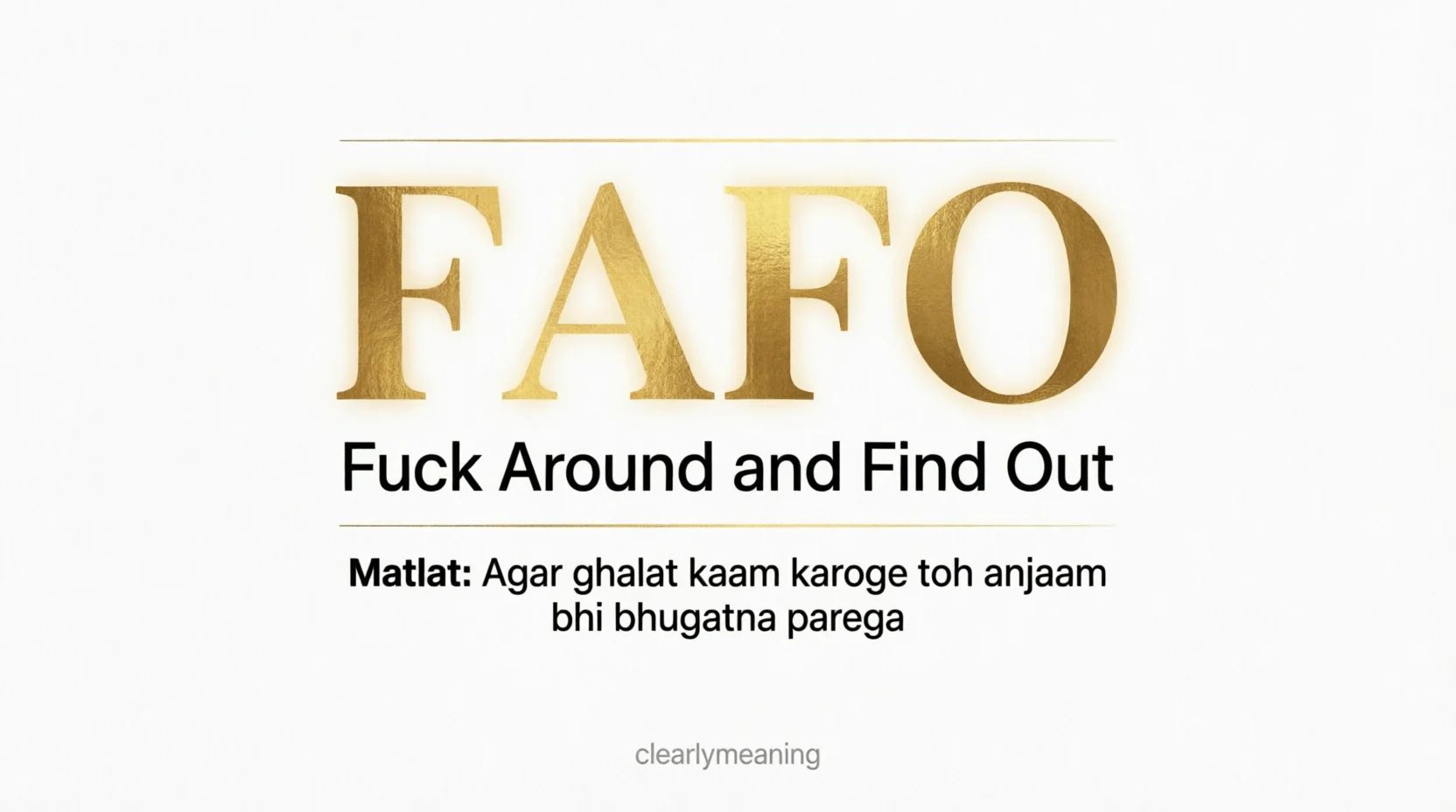
If you’ve spent any time on TikTok, X (formerly Twitter), Instagram, Reddit, or meme pages lately, you’ve probably come across the term FAFO. Maybe someone commented it under a viral video. Maybe a friend used it in a group chat. Or perhaps you saw people saying, “He decided to FAFO.”
At first glance, FAFO can look confusing if you’re unfamiliar with modern internet slang. Unlike common abbreviations such as LOL or BRB, FAFO carries a stronger message and often appears in situations where someone experiences the consequences of their actions.
So, what exactly does FAFO mean, and why has it become so popular online?
In this guide, you’ll learn the real meaning of FAFO, where it came from, how people use it on social media, examples in text conversations, and when you should (or shouldn’t) use it.
What Does FAFO Mean?
FAFO stands for “F* Around and Find Out.”**
It’s a slang phrase used to describe a situation where someone takes a risk, ignores warnings, behaves recklessly, or challenges someone—and then faces the consequences.
In simple terms, FAFO means:
If you make bad choices, push limits, or test boundaries, you’ll eventually discover the result of those actions.
The phrase is often used humorously, sarcastically, or as a warning.
Quick Definition
FAFO Meaning: A slang expression meaning that someone will experience the consequences of their actions after taking unnecessary risks or ignoring warnings.
Simple Meaning of FAFO
Imagine someone repeatedly ignores advice not to touch a hot stove.
They touch it anyway.
They get burned.
That’s essentially a FAFO situation.
The phrase suggests that some lessons are learned through experience rather than listening to warnings.
In everyday language, FAFO can mean:
- Learn the hard way
- Face the consequences
- Deal with the results of your actions
- Experience what happens when you take things too far
Why Is FAFO So Popular Online?
The internet loves short phrases that quickly communicate a bigger idea.
FAFO became popular because it summarizes an entire situation in just four letters.
Instead of saying:
“That person ignored all the warnings and ended up facing the consequences.”
People simply write:
“FAFO.”
It’s shorter, funnier, and often more impactful.
The phrase gained major popularity through:
- TikTok videos
- Meme culture
- Reddit discussions
- Gaming communities
- Social media commentary
- Viral reaction videos
Today, it’s commonly used whenever someone suffers an outcome that was predictable from the beginning.
Where Is FAFO Used?
Text Messages
Friends often use FAFO jokingly in conversations.
Example:
Friend 1: I ate that five-day-old pizza.
Friend 2: And now you’re sick?
Friend 1: Yep.
Friend 2: FAFO.
TikTok
FAFO appears frequently in comment sections.
When someone posts a video showing a risky decision gone wrong, viewers often comment:
“Classic FAFO moment.”
People use it in captions, reels, and comments.
Example:
“Guy ignored the warning signs. FAFO.”
X (Twitter)
The phrase is popular in discussions about current events, sports, and viral moments.
Users often use FAFO when discussing someone who underestimated a situation.
Reddit communities frequently use FAFO to summarize stories where someone experiences the consequences of their behavior.
FAFO Meaning on Social Media
On social media, FAFO usually implies one of three things:
1. A Warning
Someone is being told not to continue a certain behavior.
Example:
“Keep messing with that dog and FAFO.”
2. Consequences
Someone already ignored the warning and is now dealing with the results.
Example:
“He thought the rules didn’t apply to him. FAFO.”
3. Humor
Many people use FAFO in funny situations where the consequences are minor.
Example:
“I drank three energy drinks before bed. FAFO.”
Examples of FAFO in Real-Life Situations
Understanding slang is easier when you see it in context.
Example 1
Someone parks illegally despite multiple warning signs.
Their car gets towed.
People might say:
“That’s FAFO.”
Example 2
A gamer challenges an experienced player and loses immediately.
Friends comment:
“Bro really FAFO.”
Example 3
Someone ignores weather warnings and gets caught in a storm.
Response:
“FAFO moment.”
Example 4
A student procrastinates for weeks and fails an exam.
Friends joke:
“Looks like FAFO happened.”
FAFO in Text Messages
Here are some realistic chat examples.
Example Conversation #1
Alex: I told my boss exactly what I thought.
Ryan: How did that go?
Alex: Not great.
Ryan: FAFO.
Example Conversation #2
Emma: I challenged my older brother to a basketball game.
Sarah: And?
Emma: Lost by 30 points.
Sarah: FAFO.
Example Conversation #3
Jake: I stayed up until 4 AM watching videos.
Tom: Tired now?
Jake: Extremely.
Tom: FAFO.
Is FAFO Offensive?
This depends on the context.
The original phrase contains profanity because the first word is a swear word.
As a result, some people may consider FAFO slightly offensive.
However, because most users only write the abbreviation, it’s often viewed as milder than spelling out the full phrase.
Still, it’s best to avoid using FAFO in:
- Professional emails
- Workplace communication
- School assignments
- Formal conversations
For casual online conversations, it’s generally accepted.
FAFO vs Similar Internet Slang
Many people confuse FAFO with other online expressions.
Here’s how they differ:
| Slang | Meaning | Tone |
|---|---|---|
| FAFO | Face consequences after risky actions | Warning or humorous |
| LOL | Laughing out loud | Funny |
| YOLO | You only live once | Encourages taking risks |
| Karma | Consequences of actions | Reflective |
| Oops | Minor mistake | Casual |
The biggest difference is that FAFO specifically focuses on the consequences of risky behavior.
Origin of FAFO
The phrase “F*** Around and Find Out” existed long before social media.
People used similar expressions in everyday speech for years.
However, the abbreviation FAFO exploded in popularity during the 2020s thanks to:
- Internet memes
- TikTok creators
- Online communities
- Viral reaction content
Its popularity grew because it perfectly describes situations where outcomes were obvious from the start.
Today, it’s recognized by millions of internet users worldwide.
When Should You Use FAFO?
FAFO works best when discussing situations involving consequences.
Good times to use it:
- Someone ignored advice
- A risky decision backfired
- A challenge ended badly
- A person underestimated a situation
- A predictable outcome happened
Example:
“He thought he could beat the champion on his first try. FAFO.”
When Should You Avoid Using FAFO?
Avoid using FAFO when:
Professional Settings
Business communication should remain professional.
Serious Situations
If someone is experiencing a genuine tragedy or hardship, using FAFO may appear insensitive.
Formal Writing
Academic papers, reports, and professional documents are not appropriate places for internet slang.
Common Misunderstandings About FAFO
FAFO Doesn’t Always Mean Violence
Some people assume FAFO always refers to physical confrontations.
That’s incorrect.
It can refer to any consequence, including:
- Financial consequences
- Social consequences
- Embarrassment
- Failure
- Mistakes
- Unexpected outcomes
FAFO Isn’t Always Negative
Sometimes the phrase is used playfully.
For example:
“I ate an entire family-size pizza and now I can’t move. FAFO.”
The situation is humorous rather than serious.
FAFO Is Not New Slang
Although it feels modern, the phrase existed for years before becoming viral online.
Why People Like Using FAFO
There are several reasons why FAFO remains popular.
It’s Short
Four letters communicate a complete idea.
It’s Memorable
The phrase is catchy and easy to remember.
It’s Relatable
Everyone has experienced a FAFO moment at some point.
It Fits Many Situations
The phrase can apply to serious events, funny mistakes, sports, gaming, and everyday life.
Tips for Using FAFO Correctly
If you’re new to the term, keep these tips in mind.
Use It Casually
FAFO works best in informal conversations.
Understand the Context
Make sure the situation involves consequences or learning a lesson.
Avoid Overusing It
Like any slang term, repeated use can make it lose impact.
Know Your Audience
Some people may not understand internet slang, especially older audiences.
The Future of FAFO
Internet slang changes quickly.
New phrases appear every year, while older expressions disappear.
However, FAFO has remained relevant because it describes a universal concept: actions have consequences.
As long as people continue making questionable decisions online and offline, the phrase will likely remain popular.
Final Thoughts
FAFO is one of the internet’s most recognizable slang expressions. It stands for “F* Around and Find Out”** and refers to experiencing the consequences of risky, careless, or challenging behavior.
Whether it’s used in a TikTok comment, a Reddit discussion, a gaming chat, or a text message, the phrase quickly communicates a simple idea: actions have consequences.
Now that you know the meaning of FAFO, you’ll be able to understand exactly what people mean the next time you see it online—and maybe even use it yourself in the right situation.
Frequently Asked Questions
What does FAFO mean in text?
FAFO stands for “F* Around and Find Out.”** It means someone experiences the consequences of their actions after taking risks or ignoring warnings.
What does FAFO mean on TikTok?
On TikTok, FAFO is commonly used in comments and videos when someone faces a predictable consequence after making a questionable decision.
Is FAFO a bad word?
The abbreviation itself is generally acceptable online, but the full phrase contains profanity, so some people may consider it inappropriate in formal settings.
Can I use FAFO in professional communication?
No. Because the phrase originates from profanity-based slang, it’s best reserved for casual conversations and social media use.
Why is FAFO so popular?
FAFO became popular because it’s short, memorable, and effectively describes situations where someone’s actions lead directly to consequences.
descover more post
Tho Meaning The Tiny Internet Word You See Everywhere …
What Does SMD Mean in Text Real Meaning Examples 2026
ATP Meaning Slang What It Really Means And Why Everyone …

M. Khan is the writer behind ClearlyMeaning, where he breaks down difficult words and trending internet slang into simple, clear explanations. Known for his hardworking approach and attention to detail, he aims to make understanding language easy and stress-free for readers worldwide.