Have you ever received a message that simply said “IDTS” and had no idea what it meant?
You’re not alone.
The internet is full of abbreviations, acronyms, and slang terms that can make online conversations confusing, especially if you’re not familiar with texting culture. One day you’re chatting normally, and the next someone replies with “IDTS” and leaves you wondering whether it’s positive, negative, or something completely different.
The good news is that the meaning is actually quite simple.
In this guide, you’ll learn the IDTS meaning, how people use it in text messages, what it means on social media, examples of real conversations, and when you should (or shouldn’t) use it yourself.
Let’s dive in.
What Does IDTS Mean?
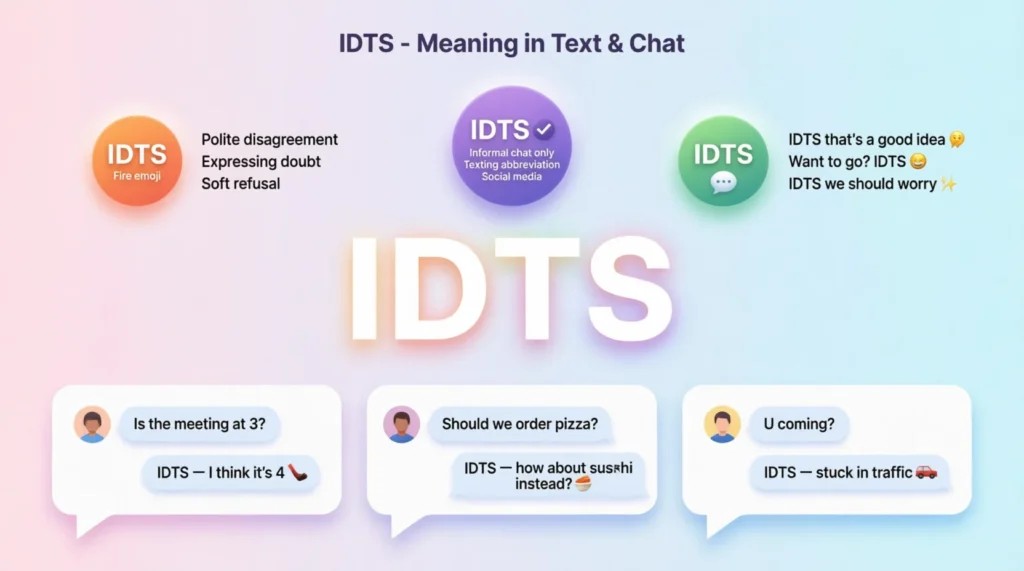
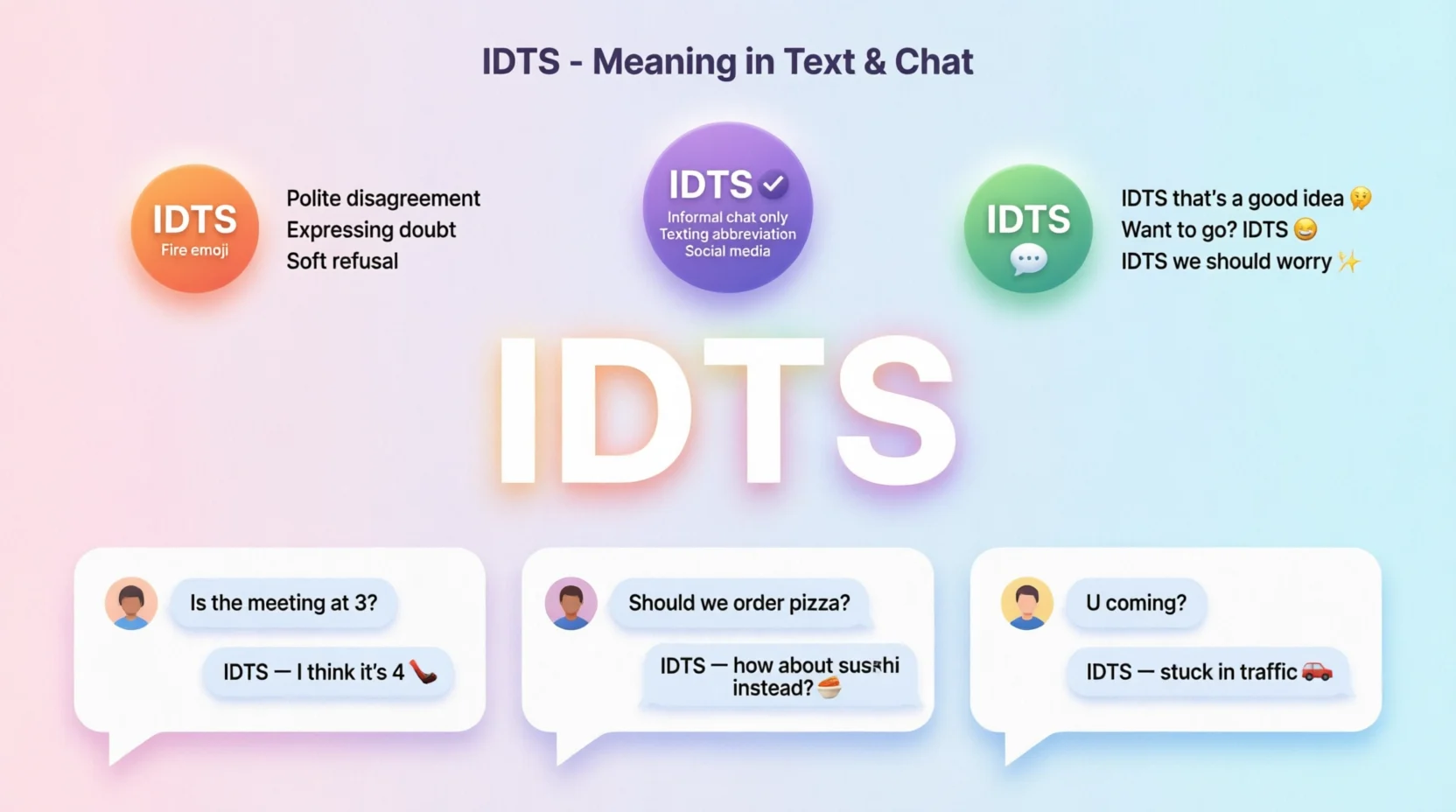
IDTS stands for “I Don’t Think So.”
It’s a common internet abbreviation used in text messages, social media comments, online chats, and messaging apps.
People use IDTS when they disagree with something, doubt that something is true, or want to politely reject an idea.
Quick Definition
IDTS = I Don’t Think So
It usually means:
- I disagree
- Probably not
- I don’t believe that’s true
- I doubt it
- That’s unlikely
The exact meaning depends on the conversation and tone.
IDTS Meaning in Text Messages
In texting, IDTS is typically used as a quick way to express doubt or disagreement without typing a full sentence.
Instead of writing:
“I don’t think that’s correct.”
Someone might simply write:
“IDTS.”
Because texting is often fast and informal, abbreviations like IDTS help people communicate more quickly.
Example
Friend: Do you think it’s going to rain today?
You: IDTS. The weather looks clear.
In this example, IDTS means:
“I don’t think so.”
The response is casual, short, and easy to understand.
What Does IDTS Mean on Social Media?
On social media platforms, IDTS is often used in comments, replies, and discussions.
People use it when:
- Disagreeing with a post
- Challenging an opinion
- Expressing skepticism
- Reacting to rumors or claims
Because social media conversations move quickly, short abbreviations are common.
Example
Post: This movie is the best film ever made.
Comment: IDTS, but it’s definitely good.
Here, the commenter respectfully disagrees without writing a lengthy response.
How IDTS Is Commonly Used
The phrase can be used in several situations.
1. Expressing Disagreement
This is the most common use.
Example:
Person A: That team is going to win the championship.
Person B: IDTS.
Meaning:
“I don’t think so.”
2. Showing Doubt
Sometimes someone isn’t completely disagreeing—they’re simply unsure.
Example:
Friend: Will the package arrive today?
You: IDTS.
Meaning:
“I doubt it.”
3. Rejecting an Idea
People also use IDTS when turning down suggestions.
Example:
Friend: Want to stay up until 4 a.m. tonight?
You: IDTS. I have work tomorrow.
Meaning:
“No, probably not.”
4. Responding to Rumors
IDTS is frequently used when discussing rumors or unverified information.
Example:
Person: I heard the app is shutting down next week.
Reply: IDTS. I haven’t seen any official announcement.
Meaning:
“I don’t believe that’s true.”
Real-Life Examples of IDTS in Conversations
Understanding slang is much easier when you see it in context.
Example 1: School Conversation
Student 1: Do you think the teacher will cancel the test?
Student 2: IDTS. She seemed serious about it.
Meaning:
The student doubts the test will be canceled.
Example 2: Sports Discussion
Fan 1: Our team is definitely winning tonight.
Fan 2: IDTS. The other team has been playing really well.
Meaning:
The fan disagrees with the prediction.
Example 3: Family Chat
Sibling: Mom will probably let us order pizza.
Sibling 2: IDTS.
Meaning:
They don’t believe that will happen.
Example 4: Social Media Comment
Post: This trend will disappear next week.
Comment: IDTS. It’s growing fast.
Meaning:
The commenter disagrees.
Is IDTS Rude?
Usually, no.
IDTS is generally considered a neutral and informal expression.
However, tone matters.
If someone responds with only:
IDTS
it may seem blunt depending on the conversation.
A friend might not mind, but in some situations adding context sounds friendlier.
For example:
Instead of:
IDTS
You could write:
IDTS, but we’ll see what happens.
Or:
IDTS because the latest update says otherwise.
These responses sound more conversational and less abrupt.
Different Ways People Write IDTS
Online slang often appears in multiple formats.
You may see:
- IDTS
- idts
- Idts
All versions mean the same thing.
Capitalization usually doesn’t change the meaning.
Most people type whichever style feels natural.
IDTS vs Similar Text Abbreviations
Many texting abbreviations express doubt or disagreement. Here’s how IDTS compares to some common alternatives.
| Abbreviation | Meaning | Usage |
|---|---|---|
| IDTS | I Don’t Think So | Doubt or disagreement |
| IMO | In My Opinion | Sharing a personal opinion |
| TBH | To Be Honest | Giving an honest viewpoint |
| NGL | Not Gonna Lie | Admitting something honestly |
| SMH | Shaking My Head | Disappointment or disbelief |
| IDC | I Don’t Care | Lack of concern |
| IMO | In My Opinion | Personal perspective |
The key difference is that IDTS specifically communicates doubt, disagreement, or skepticism.
Why People Use IDTS Instead of Writing the Full Phrase
There are several reasons why internet users prefer abbreviations.
Saves Time
Typing four letters is faster than typing:
I don’t think so
Common in Online Culture
Many people who text regularly are familiar with abbreviations.
Fits Casual Conversations
IDTS feels natural in informal chats.
Easy to Understand
Once you know the meaning, it’s straightforward and efficient.
When Should You Use IDTS?
IDTS works best in casual communication.
Good situations include:
- Text messages
- Group chats
- Social media comments
- Online forums
- Gaming chats
- Messaging apps
Examples
✅ IDTS, the game starts tomorrow.
✅ IDTS. I checked the website.
✅ IDTS but let’s find out.
These examples sound natural and conversational.
When You Should Avoid Using IDTS
Although it’s common online, IDTS isn’t appropriate everywhere.
Avoid using it in:
- Professional emails
- Job applications
- Business reports
- Academic assignments
- Formal communication
Example
Instead of writing:
IDTS that’s correct.
A professional alternative would be:
I don’t believe that’s correct.
Or:
I respectfully disagree.
Formal communication should prioritize clarity over shorthand.
Common Misunderstandings About IDTS
Misunderstanding #1: It Means “I Don’t Talk Seriously”
Some people incorrectly guess that IDTS stands for something else.
The most widely accepted meaning is:
I Don’t Think So
Misunderstanding #2: It’s Always Negative
Not necessarily.
IDTS can simply express uncertainty rather than strong disagreement.
Misunderstanding #3: It’s Offensive
In most situations, it isn’t offensive.
It’s generally considered mild and conversational.
Misunderstanding #4: Everyone Knows It
Many people still aren’t familiar with internet abbreviations.
If you’re talking to someone who may not understand online slang, writing the full phrase can be better.
How Popular Is IDTS?
IDTS has been used online for years, particularly in:
- Chat rooms
- Instant messaging platforms
- Text messaging
- Social networks
- Gaming communities
While newer slang terms appear every year, IDTS remains recognizable because it’s simple and practical.
People continue to use it whenever they want to quickly say:
“I don’t think so.”
The Evolution of Texting Slang
The rise of abbreviations like IDTS happened because digital communication became faster and more informal.
Early internet users created shortcuts to save typing time.
Examples include:
- LOL (Laugh Out Loud)
- BRB (Be Right Back)
- IMO (In My Opinion)
- IDK (I Don’t Know)
- IDTS (I Don’t Think So)
Many of these abbreviations remain part of online culture today.
Even though emojis and voice messages are now common, texting shortcuts continue to be widely used.
Tips for Using IDTS Naturally
If you want to sound natural online, keep these tips in mind.
Keep It Casual
IDTS belongs in relaxed conversations.
Add Context When Needed
Instead of writing only:
IDTS
Try:
IDTS because the announcement was postponed.
This makes your meaning clearer.
Consider Your Audience
Not everyone understands internet slang.
When communicating with older relatives, teachers, clients, or coworkers, the full phrase may be a better choice.
Don’t Overuse It
Using too many abbreviations can make messages harder to read.
Balance shorthand with regular language.
Final Thoughts
The IDTS meaning is simple once you know it.
IDTS stands for “I Don’t Think So,” and it’s commonly used in texting, social media, gaming chats, and online conversations to express doubt, disagreement, or skepticism.
It’s quick, casual, and easy to use when talking with friends or participating in online discussions.
The next time someone sends you “IDTS,” you won’t need to guess what they mean. You’ll immediately know they’re saying:
“I don’t think so.”
Understanding small internet slang terms like this can make online communication much easier and help you keep up with modern digital conversations.
Frequently Asked Questions (FAQ)
What does IDTS mean in texting?
IDTS means “I Don’t Think So.” It’s used to express doubt, disagreement, or uncertainty in a text conversation.
What does IDTS mean on social media?
On social media, IDTS usually means “I Don’t Think So” and is often used when replying to opinions, claims, rumors, or predictions.
Is IDTS rude?
No. IDTS is generally not rude. However, using it without explanation may sound blunt in some situations.
Can I use IDTS in professional emails?
It’s best not to. Professional communication should use complete phrases instead of texting abbreviations.
Is IDTS still popular?
Yes. Although many internet slang terms come and go, IDTS continues to be used in casual online conversations, messaging apps, and social media platforms.
descover more post
What Does MM Mean in Text Real Meaning Examples 2026
What Does TBC Meaning in Text Real Meaning Examples 2026
What Does WYGG Mean in Text Real Meaning Examples 2026

M. Khan is the writer behind ClearlyMeaning, where he breaks down difficult words and trending internet slang into simple, clear explanations. Known for his hardworking approach and attention to detail, he aims to make understanding language easy and stress-free for readers worldwide.