
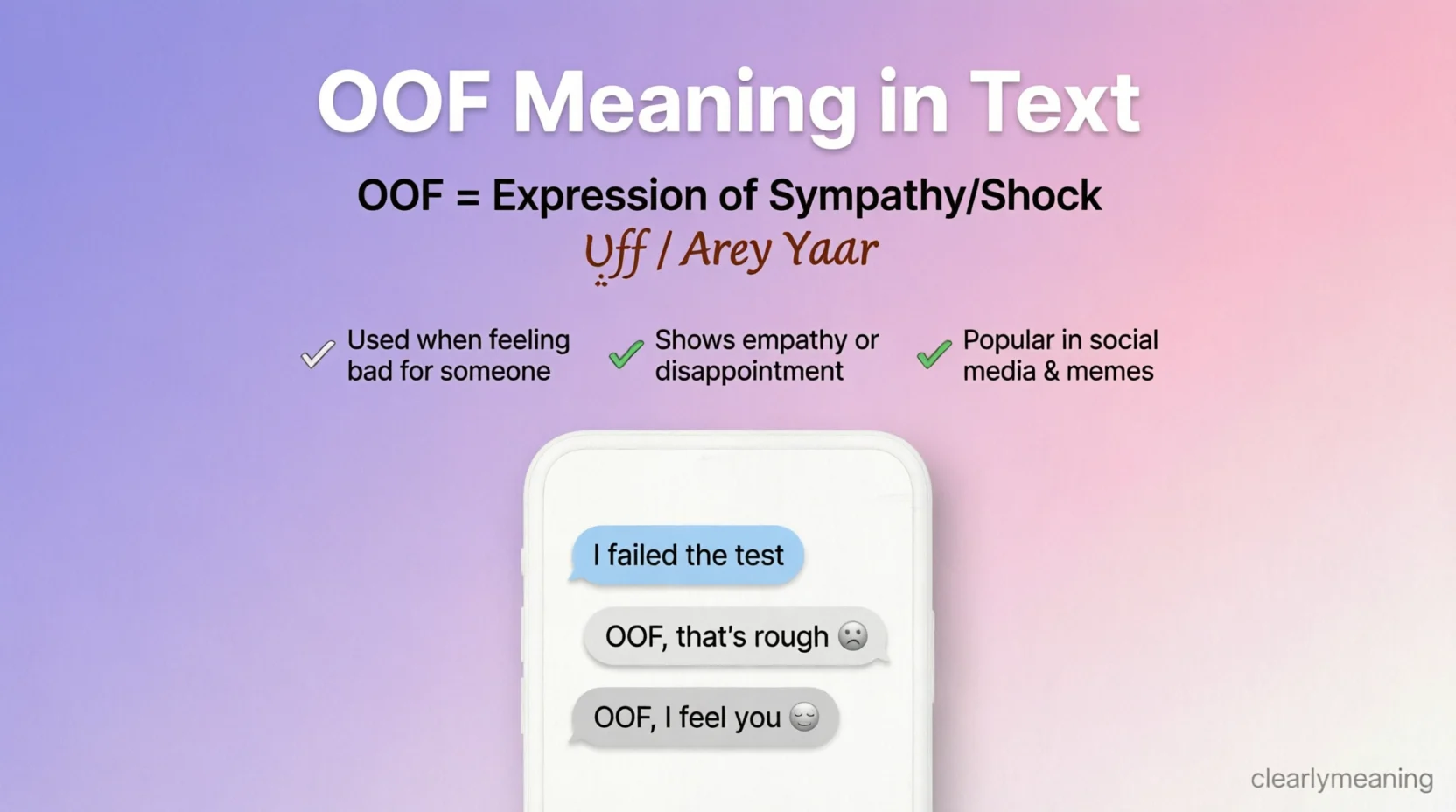
Have you ever opened a message and seen someone reply “oof”? Maybe a friend told you about a terrible day, someone shared an embarrassing story, or a game character took serious damage—and all you could think of was: “Oof.”
This short expression can say a lot without needing a full sentence.
Depending on the situation, oof can show sympathy, surprise, discomfort, disappointment, embarrassment, or even amusement. That’s what makes it such an interesting piece of internet slang. The meaning often depends less on the word itself and more on the situation, the message around it, and the way it is written.
In this guide, you’ll learn the oof meaning in text, where it came from, how people use it on social media, what different versions mean, and how to use it naturally in conversations.
What Does “Oof” Mean in Text?
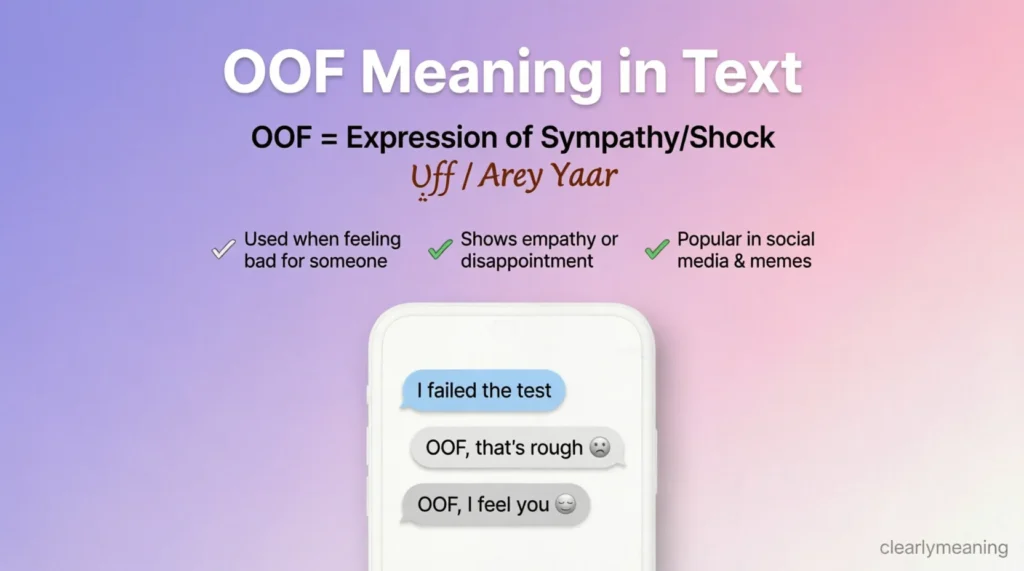
“Oof” is an informal expression used to react to something painful, awkward, unfortunate, surprising, or difficult.
In everyday texting, it can mean something like:
- “That sounds painful.”
- “That must have been difficult.”
- “That was awkward.”
- “Wow, that’s unfortunate.”
- “I felt that.”
- “That was a rough one.”
For example:
Friend: “I studied all night and still failed the test.”
You: “Oof 😬”
Here, oof expresses sympathy and recognizes that the situation was unpleasant.
The word is short, but its emotional meaning can change depending on the context.
Oof Meaning in Simple English
The easiest way to understand oof is to think of it as a quick emotional reaction.
When something happens that makes you feel uncomfortable, sorry for someone, surprised, or slightly shocked, you might say:
“Oof.”
It is similar to the sound people make when they experience a sudden impact or see something that hurts emotionally.
For example:
“I accidentally sent the message to the wrong person.”
A natural response might be:
“Oof, that’s awkward.”
In this example, the word does not necessarily mean physical pain. Instead, it reacts to an embarrassing situation.
That is why the meaning of oof is flexible. It can be serious, funny, sympathetic, or even slightly sarcastic.
Where Did “Oof” Come From?
The expression oof is often associated with the sound someone makes after being hit, falling, or experiencing a sudden impact.
Over time, people began using it more broadly in conversations. Instead of reacting only to physical pain, people started using the word for emotional pain, bad luck, awkward moments, and disappointing situations.
Online communities helped make the expression especially popular. It became common in gaming, memes, social media comments, and text messages.
Today, you might see someone type “oof” after:
- Losing a game
- Getting rejected
- Making an embarrassing mistake
- Hearing bad news
- Seeing an expensive price
- Experiencing an awkward moment
- Watching someone fail spectacularly
The word has become a simple way to acknowledge that something was rough, painful, awkward, or unfortunate.
Why Do People Say “Oof” in Text Messages?
One reason oof is so popular is that it communicates an emotional reaction quickly.
You do not always need a long response like:
“I’m sorry that happened. That sounds like a really difficult and uncomfortable situation.”
Sometimes, a simple:
“Oof 😭”
says almost everything.
People use it because it is:
Quick
It takes only a few seconds to type.
Emotional
It shows that you understand the feeling behind a situation.
Flexible
It can work for serious problems, funny mistakes, awkward moments, and minor disappointments.
Conversational
It sounds natural in casual online communication.
The exact meaning depends on the situation and the tone of the conversation.
Different Meanings of “Oof” in Text
One of the most useful things to understand is that oof does not have only one meaning.
Here are some of the most common ways people use it.
1. “That Sounds Painful”
This is probably the most direct use.
Friend: “I hit my knee on the table.”
You: “Oof!”
Here, the word is a reaction to physical pain.
It is similar to saying:
“That must have hurt.”
2. “That’s Really Unfortunate”
Someone may use oof when another person experiences bad luck.
Friend: “My flight was canceled after I arrived at the airport.”
You: “Oof, that’s rough.”
In this situation, the word expresses sympathy.
3. “That’s Awkward”
You can also use oof when someone shares an embarrassing experience.
Friend: “I waved back at someone who was waving at the person behind me.”
You: “Oof 😭”
The response means:
“That is painfully awkward.”
This is a very common use in memes and social media conversations.
4. “That Was a Bad Mistake”
Sometimes oof reacts to a mistake.
Person: “I deleted the entire presentation instead of one slide.”
Friend: “Oof.”
The meaning here is close to:
“That was a serious mistake.”
5. “That’s Disappointing”
Imagine someone says:
“My favorite restaurant was closed when I finally got there.”
You might reply:
“Oof, that’s disappointing.”
In this case, the word shows mild sympathy.
6. “Wow, That’s Expensive”
Oof is not always about pain or embarrassment.
It can also react to an unexpectedly high price.
Friend: “The new phone costs $1,500.”
You: “Oof, that’s expensive.”
Here, oof communicates shock or discomfort about the cost.
How “Oof” Is Used on Social Media
The expression is extremely common on social platforms because social media is full of quick reactions.
You might see oof in:
- TikTok comments
- Instagram comments
- Facebook posts
- Reddit discussions
- Discord servers
- YouTube comments
- Gaming communities
- Group chats
For example:
Post: “I waited two hours for the concert, then it started raining.”
Comment: “Oof.”
The commenter is expressing sympathy without writing a long message.
On social media, the word can also be used humorously.
Post: “Me checking my bank account after a weekend of shopping.”
Comment: “Oof 💀”
Here, the person is reacting to the financial consequences in a funny way.
Oof in Gaming
Gaming culture has played a major role in making oof popular online.
Players often use it when:
- Their character takes heavy damage
- They lose a match
- They make a bad move
- They fall off a map
- They lose valuable items
- They get defeated unexpectedly
For example:
Player 1: “I lost all my equipment.”
Player 2: “Oof.”
In gaming, the word may be sympathetic, funny, or simply a reaction to something unexpected.
Sometimes, players use extended versions such as:
- Oof
- Oooof
- Big oof
- Major oof
- Oof moment
These variations usually make the reaction feel stronger.
Real-Life Text Examples of “Oof”
Let’s look at some everyday examples.
Example 1: Exam Failure
Friend: “I got a 45% after studying for three days.”
You: “Oof, that hurts.”
Meaning: You feel sorry for your friend and understand the disappointment.
Example 2: Awkward Text
Friend: “I accidentally sent ‘I love you’ to my boss.”
You: “Oof 😭”
Meaning: That is extremely awkward.
Example 3: Breakup
Friend: “They broke up with me through a text message.”
You: “Oof. I’m sorry.”
Meaning: You recognize that the situation is emotionally painful.
Example 4: Expensive Purchase
Friend: “I spent my entire paycheck on a gaming setup.”
You: “Oof.”
Meaning: You are reacting to the large amount of money spent.
Example 5: Gaming
Gamer: “I was one hit away from winning.”
Friend: “Oof, so close.”
Meaning: You recognize the disappointment of almost winning.
Example 6: Embarrassing Moment
Friend: “I called my teacher ‘Mom’ in front of the whole class.”
You: “Oof 💀”
Meaning: The situation was painfully embarrassing, but also funny.
What Does “Oof” Mean With Emojis?
The emoji used with oof can change the tone.
“Oof 😭”
Usually means:
“That is so painful or unfortunate.”
Example:
“I forgot my homework at home.”
“Oof 😭”
“Oof 💀”
Often means:
“That was painfully funny or extremely embarrassing.”
Example:
“He tried to impress everyone and immediately fell.”
“Oof 💀”
“Oof 😬”
Usually suggests:
“That is awkward or uncomfortable.”
Example:
“She sent the private message to the group chat.”
“Oof 😬”
“Oof 😂”
Often makes the expression more playful.
Example:
“I spent three hours looking for my phone. It was in my hand.”
“Oof 😂”
The context always matters, but emojis can make the intended emotion easier to understand.
“Oof” vs Similar Expressions
| Expression | Common Meaning | Typical Tone |
|---|---|---|
| Oof | That sounds painful, awkward, or unfortunate | Casual and flexible |
| Yikes | That is concerning or uncomfortable | Often stronger discomfort |
| Oops | I made a mistake | Usually personal mistake |
| Oh no | Sympathy or concern | More direct |
| Damn | Surprise, shock, or emphasis | Can be stronger |
| LOL | Laughing | Humorous |
| RIP | Something is metaphorically “dead” or ruined | Dramatic or humorous |
Oof vs Yikes
These words are similar, but not identical.
Oof often reacts to pain, disappointment, or a difficult situation.
Yikes is more commonly used when something feels alarming, uncomfortable, or concerning.
Example:
“I missed my bus.”
Oof.
“He posted his private information publicly.”
Yikes.
Oof vs Oops
Oops usually means someone made a mistake.
“Oops, I forgot to attach the file.”
Oof is more often the reaction to the consequences.
“You deleted the only copy? Oof.”
Oof vs LOL
LOL shows laughter.
Oof shows a reaction to something painful, awkward, disappointing, or difficult.
Sometimes, they can appear together:
“Oof 😂 that was embarrassing.”
When Should You Use “Oof”?
You can use oof when the conversation is casual and you want to react naturally.
It works well when:
✅ A friend shares bad news
✅ Someone makes an embarrassing mistake
✅ A person experiences bad luck
✅ Something is surprisingly expensive
✅ A gaming moment goes badly
✅ A situation is awkward
✅ You want to show mild sympathy
For example:
“I missed the deadline by five minutes.”
A natural response could be:
“Oof, that’s rough.”
This sounds casual and supportive.
When Should You Avoid Using “Oof”? ⚠️
Although oof is flexible, it is not appropriate for every situation.
Be careful when someone is sharing something extremely serious, such as:
- A major personal loss
- A serious emergency
- A traumatic experience
- A deeply emotional problem
In those situations, replying only with “oof” may sound too casual or dismissive.
Instead, offer a more thoughtful response.
For example, rather than:
“Oof.”
You might say:
“I’m really sorry you’re going through that. That sounds incredibly difficult.”
The key is to match your response to the seriousness of the situation.
Common Misunderstandings About “Oof”
“Oof always means something funny.”
Not necessarily.
It can be funny, but it can also show sympathy, discomfort, disappointment, or surprise.
“Oof always means physical pain.”
No.
The expression originally sounds like a reaction to impact, but online it is commonly used for emotional and social situations too.
“Oof is rude.”
Usually, no.
However, the tone and context matter. If someone shares something serious and you reply casually with “oof,” they might feel that you are not taking them seriously.
“Oof and yikes mean exactly the same thing.”
They overlap, but they are not identical.
Oof often suggests pain, disappointment, or sympathy.
Yikes more often suggests concern, alarm, or discomfort.
“Only gamers use oof.”
Gaming communities helped popularize the word, but it is now used across many online communities and everyday conversations.
What Does “Oof Moment” Mean?
You may also see the phrase “oof moment.”
An oof moment is a situation that is:
- Painful
- Embarrassing
- Unfortunate
- Disappointing
- A major mistake
For example:
“I studied the wrong chapter for the exam. What an oof moment.”
Or:
“He forgot his own birthday party. Total oof moment.”
The phrase is often used humorously, especially in memes and social media posts.
What Does “Big Oof” Mean?
“Big oof” is an intensified version of the expression.
It means the situation is especially painful, awkward, surprising, or unfortunate.
Compare:
“I forgot my keys.”
Oof.
“I locked my keys inside my car while it was running.”
Big oof.
The second situation is clearly more serious, so the stronger expression fits better.
What Does “Oooof” Mean?
When someone stretches the word—“Oooof”—they usually want to make the reaction more dramatic.
The extra letters can suggest:
- Stronger sympathy
- Greater shock
- More embarrassment
- A more dramatic reaction
For example:
“I accidentally deleted my entire project.”
“Oooof 😭”
The extended spelling makes the response feel more emotional.
How to Use “Oof” Naturally in a Conversation
If you want to use the word naturally, pay attention to the situation.
Use it as a standalone reaction:
“I forgot my wallet.”
“Oof.”
Add a short explanation:
“Oof, that sounds painful.”
Use it with humor:
“Oof 💀 you really did that?”
Use it with sympathy:
“Oof, I’m sorry. That’s rough.”
The best responses often combine the expression with a few extra words.
For example:
“Oof, that must have been embarrassing.”
This sounds more thoughtful than simply sending the word alone.
Pro Tips for Using “Oof” Correctly 💡
1. Pay attention to context
The same word can sound funny in one conversation and insensitive in another.
2. Use emojis to clarify your tone
A crying, laughing, or uncomfortable emoji can help show what you mean.
3. Add words when the situation is serious
Instead of only saying “oof,” try:
“Oof, I’m really sorry.”
This makes your response feel more supportive.
4. Use extended versions for dramatic moments
Oooof or big oof can make a reaction more expressive.
5. Do not force it
Internet slang sounds most natural when it fits your usual way of speaking.
If you would normally say “That’s rough,” you do not have to replace it with “oof.”
Final Thoughts
The oof meaning in text is simple but surprisingly flexible.
It is a casual reaction used when something is painful, awkward, unfortunate, disappointing, surprising, or difficult. Depending on the context, it can express sympathy, humor, shock, or discomfort.
You might say “oof” after a friend shares an embarrassing story, a gamer loses at the last second, or someone experiences a frustrating day.
The most important thing is to understand the situation before using it. In casual conversations, oof is a quick and natural way to show that you recognize someone’s struggle—or that a situation was so awkward you almost felt it yourself. 😭
So, the next time someone tells you:
“I sent the message to the wrong person.”
You already know the perfect reaction:
“Oof 😬”
Frequently Asked Questions
What does oof mean in texting?
In texting, oof is a casual reaction to something painful, awkward, disappointing, surprising, or unfortunate. Its exact meaning depends on the conversation.
Is oof a positive or negative word?
Oof is usually a reaction to something negative, uncomfortable, or difficult, but it can also be used humorously in casual conversations.
Is oof the same as yikes?
Not exactly. Oof often expresses sympathy or a reaction to pain and disappointment, while yikes usually shows concern, alarm, or discomfort.
Can I use oof in professional messages?
It is best to avoid slang like oof in formal emails and professional communication. It is mainly used in casual chats, social media, gaming, and friendly conversations.
descover more post
Tho Meaning The Tiny Internet Word You See Everywhere …
GLHF Meaning in Text The Friendly Gaming Phrase Everyone …
TFW Meaning The Internet Slang Everyone Uses but Few Fully …

Navo is the voice behind ClearlyMeaning, where he breaks down confusing words and trending internet slang into simple, clear explanations. Known for his hardworking approach and attention to detail, he aims to make learning meanings quick, easy, and stress-free for readers. His goal is to provide helpful content that truly adds value.