
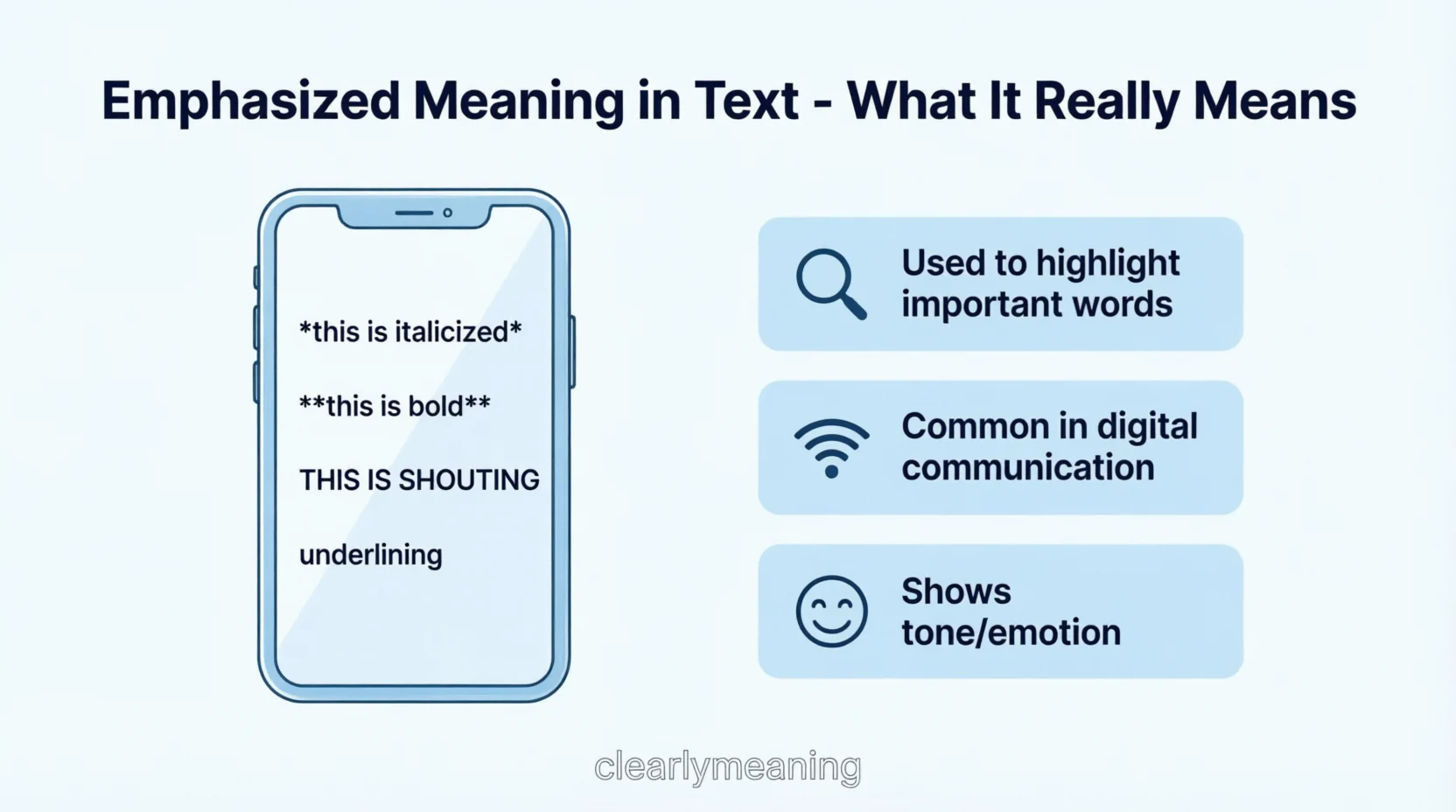
Have you ever received a text where one word suddenly feels extra important?
Maybe someone writes “I said NO.” Or they send “I REALLY need you to listen.” Sometimes, the emphasis comes from capital letters, bold formatting, repeated words, emojis, or even punctuation like !!!
If you have searched for the emphasized meaning in text, you are probably trying to understand what the sender is really trying to say. Is the person angry? Excited? Serious? Sarcastic? Or are they simply trying to make sure you notice one particular word?
The answer depends on the context, but one thing is clear: emphasizing something in a text means giving it extra importance or emotional weight.
Let’s break it down in a simple way so you can understand exactly what emphasis means in texting, social media, chats, and everyday digital conversations.
What Does “Emphasized” Mean in Text?
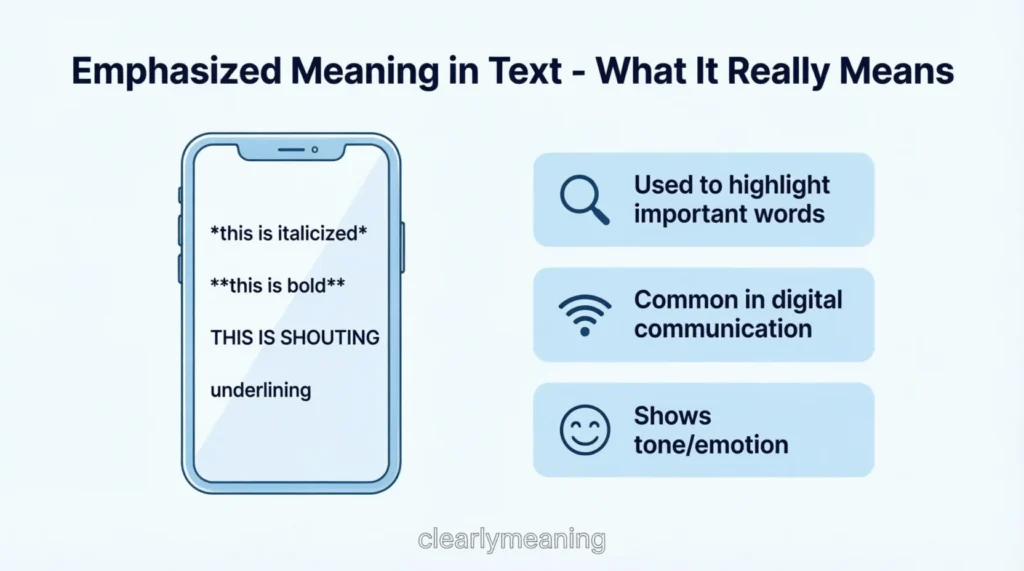
The emphasized meaning in text is when a person gives extra attention, importance, or emotional force to a particular word, phrase, or message.
In simple terms, if someone emphasizes something, they want you to notice it more than the other words.
For example:
- “I really like this.”
- “I said NO.”
- “You are definitely coming, right?”
- “That was so funny 😂”
- “Please, please listen to me.”
The emphasized word carries more meaning than it would normally have.
Quick definition:
Emphasized in text means making a word, phrase, or idea stand out to show extra importance, emotion, seriousness, or intensity.
The exact meaning can change depending on the conversation. A capitalized word may show anger or urgency, while repeated letters may show excitement.
Emphasized Meaning in Text: Simple Explanation
Imagine you are speaking to someone face-to-face.
If you want to make a word important, you might:
- Say it louder
- Change your tone of voice
- Pause before saying it
- Repeat it
- Stress a specific word
Text messages do not include your voice or facial expressions, so people use different writing techniques to create emphasis.
For example, compare these two messages:
“I’m fine.”
and
“I’m REALLY fine.”
The second message gives extra attention to the word “really.” Depending on the situation, it could mean the person is genuinely okay—or they might be trying to convince you that they are okay.
That is why context matters so much when understanding emphasis in texting.
How Do People Emphasize Words in Text Messages?
There are many ways people add emphasis to their messages. Some are obvious, while others depend on the person’s texting style.
1. Using Capital Letters 🔥
Capital letters are one of the most common ways to emphasize a word.
Examples:
- “I LOVE this song!”
- “Do NOT touch my food.”
- “I am SERIOUS.”
- “That was SO unexpected.”
Capital letters can show:
- Strong emotion
- Anger
- Excitement
- Urgency
- Importance
However, writing an entire message in capital letters can sometimes feel like shouting.
For example:
“I NEED TO TALK TO YOU NOW!”
This usually feels much more intense than:
“I need to talk to you now.”
2. Repeating a Word
People often repeat words to add emotional emphasis.
Examples:
- “No, no, no!”
- “Pleaseee!”
- “I really, really want to go.”
- “That was sooooo funny!”
The repetition can express excitement, frustration, desperation, surprise, or humor.
For example:
“Please help me.”
sounds normal.
But:
“Please, please help me 😭”
feels much more emotional.
3. Using Bold or Italic Formatting
Some messaging apps and social media platforms allow users to format text.
Examples:
- This is important.
- I really mean it.
- Do not forget this.
Formatting makes certain words visually stand out.
When someone bolds or italicizes a word, they may be drawing your attention to a specific part of their message.
4. Using Punctuation
Punctuation can completely change the feeling of a text.
Compare:
“You did it.”
“You did it!”
“You did it???”
“You did it…”
These messages contain almost the same words, but the emotional meaning is different.
- ! can show excitement, surprise, or anger.
- ??? can show confusion or disbelief.
- … can suggest hesitation, sadness, awkwardness, or suspicion.
5. Using Emojis
Emojis can also emphasize emotion.
For example:
- “I can’t believe you did that 😭”
- “That was amazing 🔥”
- “I am serious 😤”
- “Please don’t do this 🙏”
The words may be simple, but the emoji adds emotional emphasis.
Why Do People Emphasize Words in Text?
People emphasize words for many different reasons. Usually, they want to make their meaning clearer or express stronger emotion.
To Show Importance
Sometimes a person wants you to focus on one particular detail.
Example:
“Please remember that the meeting is TOMORROW.”
The capitalized word shows that the timing is important.
To Express Strong Emotion
Emphasis can make emotions stronger.
Example:
“I am SO excited to see you!”
The word “so” adds extra excitement.
To Avoid Being Misunderstood
Text messages can sometimes sound cold or unclear. Emphasis helps the sender communicate their intended tone.
For example:
“Thank you.”
could sound formal or even slightly cold.
But:
“Thank you so much!!! 🥹”
clearly feels warmer and more emotional.
To Show Seriousness
A person may emphasize a word when they want you to understand that they are not joking.
Example:
“I am SERIOUS. Please stop.”
The emphasis makes the warning stronger.
To Add Humor or Sarcasm
Emphasis is also common in jokes and sarcastic messages.
Example:
“Wow, you are SO helpful 🙄”
Here, the emphasis may actually make the sarcasm stronger.
Real-Life Examples of Emphasized Meaning in Text
Understanding examples is often the easiest way to understand the concept.
Example 1: Excitement
Text:
“I FINALLY got the job!!!”
The capital letters and exclamation marks show strong excitement.
The sender is not simply sharing information. They are expressing a big emotional reaction.
Example 2: Anger
Text:
“I told you NOT to do that.”
The emphasized word NOT shows frustration or anger.
The sender wants to make the instruction very clear.
Example 3: Seriousness
Text:
“I am being completely serious.”
If someone emphasizes completely serious, they are making it clear that the conversation should not be treated as a joke.
Example 4: Surprise
Text:
“You actually did it?!”
The punctuation emphasizes the speaker’s surprise.
The person may be shocked or unable to believe what happened.
Example 5: Emotional Pleading
Text:
“Pleaseee don’t leave 😭”
The extended spelling of “please” adds emotional emphasis.
It can make the message sound more desperate, playful, or emotional.
Example 6: Sarcasm
Text:
“Yeah, that was REALLY smart.”
Depending on the situation, the emphasized word “really” may be sarcastic.
The person might actually mean the opposite.
⚠️ This is why you should never interpret emphasized text without looking at the full conversation.
Emphasized vs Highlighted vs Stressed: What’s the Difference?
These words are similar, but they are not always used in exactly the same way.
| Term | Meaning in Text | Example |
|---|---|---|
| Emphasized | Given extra importance or emotional force | “I really mean it.” |
| Highlighted | Made visually noticeable | “Read the bold sentence.” |
| Stressed | Given special importance, often verbally or emotionally | “I stressed that it was urgent.” |
| Bolded | Made visually darker or thicker | Important |
| Capitalized | Written in uppercase letters for attention or intensity | “STOP!” |
In everyday texting, these ideas often overlap.
For example, writing “IMPORTANT” in capital letters both highlights and emphasizes the word.
Does Emphasized Text Always Mean Anger?
No. This is one of the most common misunderstandings.
Emphasis can express many different emotions, including:
- Excitement
- Happiness
- Anger
- Fear
- Surprise
- Urgency
- Humor
- Sarcasm
- Love
- Frustration
For example:
“I LOVE YOU SO MUCH!!! ❤️”
is positive and affectionate.
But:
“I TOLD YOU TO STOP!!!”
is clearly angry or frustrated.
The same technique—capital letters and exclamation marks—can communicate completely different emotions depending on the words and situation.
Where Is Emphasized Text Commonly Used?
You can see emphasized text almost everywhere people communicate online.
Text Messaging
People emphasize words in regular SMS messages and private chats.
Social Media
On platforms like social media, users emphasize words in:
- Captions
- Comments
- Posts
- Stories
- Direct messages
Online Gaming
Gamers often use capital letters to show excitement, frustration, or urgency.
Example:
“WATCH OUT!”
Work and Professional Communication
Emphasis can be useful in emails and workplace chats, but it should be used carefully.
For example:
“Please submit the report by Friday.”
This makes the deadline clear.
However, writing an entire professional email in capital letters may appear aggressive.
Online Forums and Communities
People use formatting, repeated punctuation, and capital letters to make important points stand out.
When Should You Use Emphasis in Text?
Emphasis is useful when you want your message to be clear, emotional, or memorable.
You can use it when:
You Need to Make Something Clear
“The deadline is TODAY.”
You Want to Show Excitement
“I finally passed the exam!!! 🎉”
You Are Joking
“I am totally not jealous 😂”
You Want to Show Strong Emotion
“I really, really miss you.”
You Need to Warn Someone
“Do NOT open that door.”
The key is to use emphasis naturally. If every word is emphasized, nothing feels special anymore.
When Should You Avoid Overusing Emphasis?
Too much emphasis can make your message confusing or dramatic.
For example:
“I REALLY REALLY REALLY REALLY LOVE THIS SO MUCH!!! 🔥🔥🔥”
This may be perfectly fine among close friends, but it may feel excessive in a professional conversation.
You should also be careful with capital letters.
A message like:
“WHY DID YOU DO THAT I TOLD YOU NOT TO”
can look aggressive, even if you did not intend to sound angry.
✅ Pro tip: If you are worried about your tone, read the message as if someone else sent it to you. This can help you notice how it might sound.
Common Misunderstandings About Emphasized Text ⚠️
Misunderstanding 1: Capital Letters Always Mean Anger
Not necessarily.
Some people naturally type in capital letters when they are excited or joking.
Misunderstanding 2: Repeated Words Always Mean Desperation
Repeating a word can also be playful.
For example:
“Noooo 😂”
may simply be a funny reaction.
Misunderstanding 3: Exclamation Marks Always Mean Excitement
Multiple exclamation marks can show excitement, anger, urgency, or surprise.
Context decides the meaning.
Misunderstanding 4: Emphasized Text Has One Universal Meaning
There is no single emotional meaning.
The same emphasized word can mean different things in different conversations.
For example:
“Fine.”
“FINE!”
“FINEEE 😭”
Each one feels different.
Misunderstanding 5: Emphasis Is Always Intentional
Sometimes people accidentally use caps lock or extra punctuation.
That is why you should consider the entire conversation before assuming someone’s emotional intention.
How to Understand the Real Meaning Behind Emphasis
If someone sends you an emphasized message and you are unsure what they mean, look at these clues:
Look at the Words
What exactly is being emphasized?
The word itself may reveal the emotion.
Look at the Punctuation
Are there question marks, exclamation marks, or periods?
These can change the tone.
Look at the Conversation
What was being discussed before the message?
Context is often the biggest clue.
Consider the Person
How does this person usually text?
If they always use capital letters, it may not mean they are angry.
Look at Emojis
Emojis can clarify whether the message is playful, emotional, serious, or sarcastic.
🔥 The best way to understand emphasized text is to read the message as part of the whole conversation—not as a single isolated word.
Pro Tips for Using Emphasis Naturally ✅
Here are a few simple tips to make your own messages clearer:
- Use bold or capital letters for truly important words.
- Use emojis to add emotion when appropriate.
- Avoid writing entire professional messages in capital letters.
- Use punctuation to make your tone clearer.
- Do not emphasize every word.
- Remember that different people interpret texting styles differently.
- When in doubt, add a short explanation instead of relying only on punctuation.
For example, instead of:
“I AM FINE!!!”
You could say:
“I’m fine, seriously 😊”
This makes your intended tone much clearer.
Final Thoughts
The emphasized meaning in text is all about giving extra importance, emotion, or attention to a specific word, phrase, or message.
People use capital letters, repeated words, bold formatting, punctuation, emojis, and other writing styles to make their messages stand out.
However, emphasis does not have one fixed meaning. It can show excitement, anger, seriousness, humor, sarcasm, urgency, or affection.
The best way to understand it is to look at the context, wording, punctuation, and the person’s usual texting style.
So, the next time someone writes “I REALLY mean it” or “NO!!!”, you will know that the extra emphasis is there to make the message feel stronger or more important. 💬✨
Frequently Asked Questions
What does emphasized mean in a text message?
Emphasized means that a word, phrase, or idea has been given extra importance or emotional strength. People may use capital letters, repetition, bold text, punctuation, or emojis to emphasize something.
Does emphasis in texting mean someone is angry?
Not always. Emphasis can show anger, but it can also express excitement, surprise, urgency, humor, sarcasm, or strong affection. The meaning depends on the context.
Why do people capitalize words in text messages?
People often use capital letters to make a word stand out or show strong emotion. Depending on the situation, capital letters can communicate excitement, urgency, seriousness, or anger.
How can I tell what an emphasized text really means?
Look at the entire conversation, the words being emphasized, punctuation, emojis, and the sender’s normal texting style. Context is the most important clue.
descover more post
What Does What Is FAFO Stand For Mean in Text Real …
What Does IG Mean in Slang The Real Meaning You Need to …
Tho Meaning The Tiny Internet Word You See Everywhere …

Kairo is the voice behind ClearlyMeaning, where he breaks down difficult words and trending slang into simple, clear explanations. Known for his hardworking approach and attention to detail, he aims to help readers understand meanings in the easiest way possible. His goal is to make learning fast, practical, and stress-free for everyday users.