
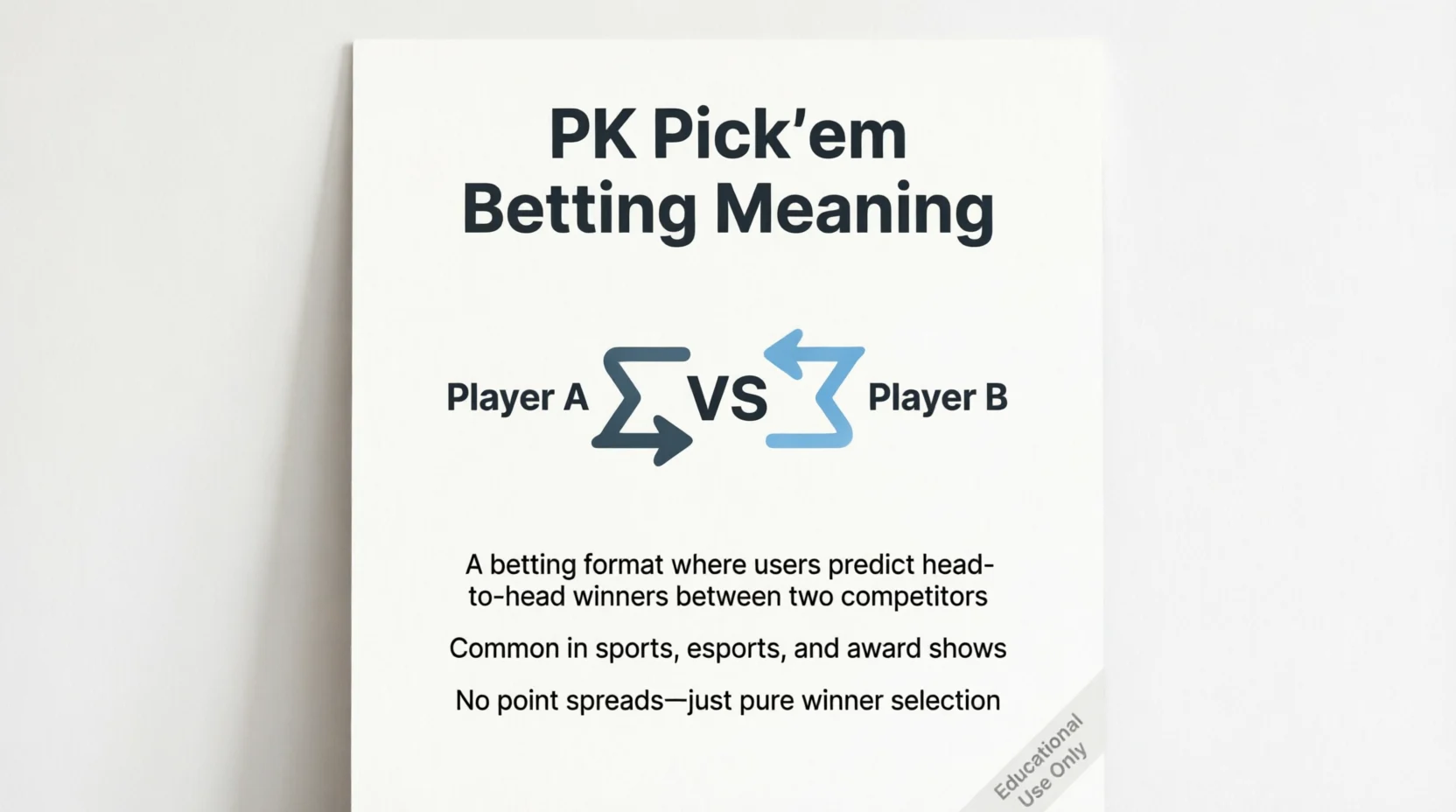
If you have ever looked at a betting slip, sportsbook, or sports chat and seen “PK”, you may have wondered what it means. Is it a team abbreviation? A special betting market? Or something connected to the final score? 🤔
In betting, PK usually means “pick’em.” It describes a wager where neither team is given a point spread advantage. In other words, the sportsbook treats both sides as essentially equal in the matchup.
For example, if you see:
Team A PK vs. Team B
there is no +3.5 or -3.5 point spread. You simply choose which team you believe will win.
That sounds simple, but the exact meaning and betting rules can vary slightly depending on the sport, sportsbook, and market. In this guide, you’ll learn what PK means in betting, how it works, how it differs from a normal spread, and what to watch out for before placing a wager. 👇
What Does PK Mean in Betting?
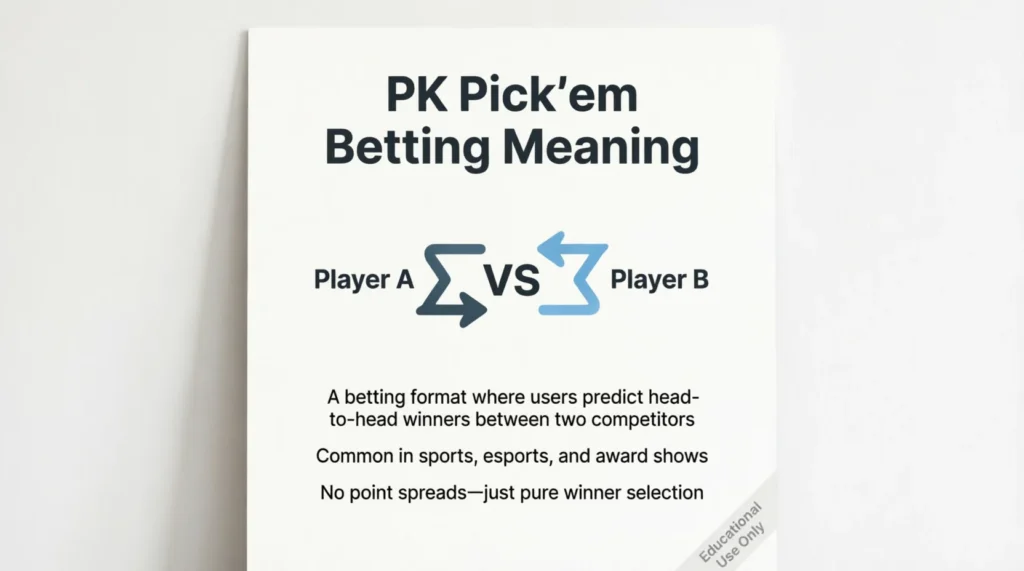
PK means “pick’em” in sports betting.
A PK line means the sportsbook has set the point spread at 0. Neither team receives an advantage or disadvantage in the spread market.
Simple example:
- Team A: PK
- Team B: PK
If you bet on Team A, Team A must simply win the game for your bet to win.
If you bet on Team B, Team B must win.
There is no point spread to cover.
In simple words:
👉 PK = Pick’em = No point spread
This is why PK betting is often considered one of the easiest spread markets to understand. Instead of asking, “Can this team win by more than 7 points?” you are simply asking:
“Which team will win?”
What Does “Pick’em” Mean?
The word pick’em comes from the idea that the teams are considered evenly matched.
The sportsbook is essentially saying:
“We don’t believe either team deserves a point-spread advantage.”
So instead of:
- Team A -3.5
- Team B +3.5
you may see:
- Team A PK
- Team B PK
The PK line does not mean the teams are guaranteed to be equal in every way. One team may still have better recent form, stronger players, or a home-field advantage.
It simply means the sportsbook is not assigning a spread advantage to either side in that particular market.
How Does PK Betting Work?
The basic process is straightforward.
Imagine a basketball game between the Lions and the Tigers.
The betting market shows:
- Lions: PK
- Tigers: PK
You choose the Lions.
If the Lions win:
✅ Your spread bet wins.
If the Tigers win:
❌ Your spread bet loses.
Because the spread is 0, the team you choose must win the game.
There is no requirement for them to win by a certain number of points.
What Happens If the Game Ends in a Tie?
This is where things can become slightly more complicated. ⚠️
The result of a PK bet may depend on the sport and the sportsbook’s rules.
In some sports, a tie can result in a push. A push generally means the wager is canceled and the original stake is returned.
For example:
- You bet Team A PK.
- The game ends in a draw.
- The sportsbook may return your stake because neither side won.
However, not every sport handles ties in exactly the same way.
Some markets may use overtime to determine the winner, while others may settle the bet based on the result after regulation time.
👉 Always check the specific market rules before placing a bet, especially for sports where ties are possible.
PK vs. a Regular Point Spread
The biggest difference between a PK bet and a normal point spread is the margin required for victory.
Example of a normal spread:
- Team A: -4.5
- Team B: +4.5
If you bet Team A, they must win by 5 or more points.
If you bet Team B, they can either win the game or lose by 4 points or fewer.
Now compare that with:
- Team A: PK
- Team B: PK
If you bet Team A, Team A only needs to win.
Quick comparison:
| Betting Line | What It Means |
|---|---|
| Team A -7 | Team A must win by more than 7 points |
| Team B +7 | Team B can lose by fewer than 7 points |
| Team A PK | Team A must simply win |
| Team B PK | Team B must simply win |
The PK line removes the point advantage and turns the market into a simple winner-versus-winner selection.
Why Do Sportsbooks Offer PK Lines?
Sportsbooks use PK lines when they believe a matchup is extremely close.
A game may have:
- Two similarly rated teams
- Comparable recent performances
- Similar statistical profiles
- A balanced matchup
- A strong team playing a weaker team at home
- Injuries that make the matchup difficult to evaluate
For example, a team might be stronger overall but playing away from home. Another team might be weaker on paper but has a major home advantage.
The sportsbook may decide that the matchup is effectively even and set the line at PK.
That does not necessarily mean the sportsbook believes the teams are identical. It simply means the expected difference between them is not large enough to create a meaningful spread.
PK Meaning in Different Sports
The meaning of PK is generally connected to a pick’em line, but the way the market works can vary depending on the sport.
PK in Basketball 🏀
In basketball, a PK line means there is no point spread.
For example:
- Warriors PK
- Lakers PK
If you choose the Warriors, they must win the game.
A basketball game usually has a winner, especially if overtime is included, so the market is often relatively straightforward.
PK in Football 🏈
In football betting, PK means the spread is set at zero.
For example:
- Team A PK
- Team B PK
You are choosing which team will win.
However, football can sometimes end in a tie, depending on the league and competition rules. That means you should understand whether the sportsbook uses overtime or applies a push rule.
PK in Soccer ⚽
Soccer can be a little different because draws are common.
A sportsbook may offer a PK or pick’em market where you choose between two sides. However, the settlement rules may depend on whether the market includes:
- Regulation time only
- Extra time
- Penalty shootouts
Do not assume every “PK” market is identical.
The wording of the specific betting market matters.
PK in Baseball ⚾
Baseball betting markets can also use pick’em-style lines, especially when the matchup is considered very close.
The market may appear as:
- Team A 0
- Team B 0
or simply as a pick’em market.
Baseball betting rules can vary based on whether the game is completed, postponed, or suspended, so checking the sportsbook’s rules is important.
Is PK the Same as Moneyline Betting?
Not exactly—but they can look very similar.
A moneyline bet asks you to choose the winner.
A PK spread bet also generally requires your selected team to win when the spread is zero.
So the result can appear almost identical.
For example:
Moneyline:
- Team A: -110
- Team B: +100
PK spread:
- Team A: -110
- Team B: -110
The main difference is the way the sportsbook prices the market.
A PK spread is technically a point-spread market with a zero-point handicap. A moneyline is a separate market that focuses directly on the winner.
The odds may also be different.
PK vs. Moneyline: A Simple Comparison
| Feature | PK Betting | Moneyline Betting |
|---|---|---|
| Main idea | Pick the team to win | Pick the team to win |
| Point spread | 0 | No spread |
| Can odds differ? | Yes | Yes |
| Tie rules | Depends on market | Depends on market |
| Main risk | Your team must win | Your team must win |
In many situations, the two markets can produce similar outcomes, but the price and settlement rules may differ.
That is why experienced bettors often compare the available markets instead of automatically choosing the first option they see.
What Does PK Mean on a Betting Slip?
If you see PK on a betting slip, it usually means your selected team has a zero-point spread.
For example:
Eagles PK
This means the Eagles are being treated as a pick’em against their opponent.
If the Eagles win, your bet generally wins.
If the Eagles lose, your bet generally loses.
If the game ends in a tie, the sportsbook’s rules determine what happens.
Real-Life Betting Examples
Let’s look at some simple examples.
Example 1: Basketball
The market shows:
Bulls PK vs. Heat PK
You choose the Bulls.
Final score:
Bulls 108 – Heat 102
The Bulls won, so your PK bet wins. ✅
Example 2: Football
The market shows:
Eagles PK vs. Cowboys PK
You choose the Cowboys.
Final score:
Eagles 24 – Cowboys 20
The Cowboys lost, so the PK bet loses. ❌
Example 3: Soccer
You choose:
Team A PK
The match ends:
Team A 1 – Team B 1
Whether your wager is a push, loss, or settled according to another rule depends on the specific market conditions.
This is why soccer PK markets deserve extra attention.
Why Do Bettors Choose PK Lines?
There are several reasons someone may prefer a PK market.
1. No need to predict the winning margin
With a traditional spread, you may correctly predict the winner but still lose the bet.
For example:
You bet Team A -6.5.
Team A wins by 4 points.
Team A won the game, but your spread bet loses.
With PK, you only need Team A to win.
2. Easier to understand
For beginners, a PK market can be easier to follow.
You don’t have to calculate:
- Whether a team covered the spread
- Whether the final margin was enough
- Whether a late score changed the result
The basic question is simply:
Which team wins?
3. Useful in close matchups
When two teams appear evenly matched, some bettors prefer to analyze the game without worrying about a large spread.
They may focus on:
- Recent performance
- Injuries
- Home advantage
- Team statistics
- Head-to-head results
- Starting players
What Should You Check Before Betting a PK Line?
Even though PK betting looks simple, there are still several important things to consider. ⚠️
Check the odds
A PK line does not mean both teams have identical odds.
You may see:
- Team A PK -115
- Team B PK -105
The difference reflects the sportsbook’s pricing.
Check the venue
Home advantage can make a huge difference.
A team that looks weaker overall may perform much better at home.
Likewise, a strong team may struggle when playing away.
Check injuries
One important player being unavailable can dramatically change a close matchup.
Before making a decision, check whether key players are:
- Injured
- Suspended
- Resting
- Questionable
- Returning from an injury
Check the market rules
This is especially important in sports where a tie is possible.
Read the sportsbook’s settlement rules to understand:
- Whether overtime counts
- Whether extra time counts
- What happens in a draw
- What happens if the event is postponed
- What happens if the game is abandoned
Common Mistakes Beginners Make With PK Betting
Mistake 1: Thinking PK means “guaranteed winner”
It does not.
A PK line means there is no point spread advantage. It does not mean the sportsbook knows the game will be close or that either team is guaranteed to win.
Mistake 2: Assuming PK always means identical odds
Not necessarily.
The spread can be PK while the prices on both sides are different.
Always check the actual odds.
Mistake 3: Ignoring tie rules
This is a common mistake in sports where a draw is possible.
A tie may result in:
- A push
- A refunded stake
- A different settlement depending on the market
Do not guess.
Mistake 4: Confusing PK with a penalty kick
This is particularly common in soccer. ⚽
In soccer discussions, PK can also mean penalty kick.
But in a betting line, PK often means pick’em.
Context matters:
- “The player scored from the PK spot.” → Penalty kick
- “Team A is PK tonight.” → Pick’em betting line
The same abbreviation can have completely different meanings.
PK Betting vs. “PK” in Soccer
This distinction is especially important.
In soccer:
PK = Penalty Kick
A penalty kick is a set-piece opportunity awarded after certain fouls inside the penalty area.
In sports betting:
PK = Pick’em
It means the spread is effectively zero.
So if you see PK on a sportsbook, don’t immediately assume it means a penalty kick.
Look at the surrounding information.
When Should You Use a PK Bet?
A PK market may be worth considering when:
✅ You strongly prefer one team to win
✅ You do not want to predict a winning margin
✅ The matchup is close
✅ The point spread is zero
✅ The odds offer better value than another market
However, the fact that a line is PK does not automatically make it a good bet.
You still need to evaluate the matchup and the price.
When Should You Be Careful? ⚠️
You should be especially careful when:
- The odds are heavily juiced
- A major player is questionable
- The sport allows ties
- The market rules are unclear
- The line has moved significantly
- You are betting based only on team popularity
A PK line may look simple, but the odds still matter.
For example, choosing a team at -150 is different from choosing that same team at -105.
The team still needs to win, but the potential return and implied probability are different.
How Line Movement Can Affect a PK Market
Sportsbook lines can change before a game begins.
A matchup may start as:
- Team A PK
- Team B PK
Later, the line could move to:
- Team A -1.5
- Team B +1.5
This may happen because of:
- Injury news
- Betting activity
- Weather conditions
- Lineup changes
- New information about the teams
A PK line can therefore be a snapshot of how evenly matched the sportsbook considers the teams at a particular moment.
What Does “PK” Mean in Betting Odds?
When PK appears next to a team, it usually means the team is listed at a zero-point spread.
The odds next to it tell you the price of the wager.
For example:
Team A PK (-110)
This means:
- Team A is the pick’em side
- The spread is 0
- The odds are -110
The PK and the -110 provide different pieces of information.
👉 PK tells you the spread.
👉 The odds tell you the price.
Understanding this difference can help you read betting markets more accurately.
Helpful Tip: Don’t Focus Only on the Word PK
When you see a PK line, also look at:
- The sport
- The competition
- The teams
- The odds
- The market rules
- The game format
The abbreviation itself is only one part of the betting information.
A smart approach is to understand the complete market rather than making a decision based on a single label.
Common Questions About PK Betting
What does PK stand for in betting?
PK usually stands for “pick’em.” It means the point spread is zero, so neither team receives a spread advantage. The team you choose generally needs to win the game.
Is PK the same as a 0 spread?
Yes. In most sports betting contexts, PK represents a zero-point spread.
For example:
Team A PK is effectively the same as Team A 0 on the spread.
Does PK mean both teams are equally likely to win?
Not necessarily.
A PK line means the sportsbook has not assigned a point-spread advantage to either team. The actual odds can still show that one team is slightly favored.
What happens if a PK game ends in a tie?
The result depends on the sport and the sportsbook’s rules. A tie may lead to a push or another settlement method, so always check the specific market rules before placing a wager.
Is PK the same as a penalty kick?
No, not always.
In soccer, PK can mean penalty kick. In sports betting, however, PK commonly means pick’em, or a zero-point spread.
Final Thoughts
So, what does PK mean in betting?
In most sports betting situations, PK means “pick’em.” It indicates a zero-point spread, meaning neither team receives a points advantage.
If you choose a team at PK, that team generally needs to win the game for your spread bet to win.
The concept is simple, but the details can vary depending on the sport and sportsbook. That’s why you should always check the odds, understand the rules, and pay attention to whether the market includes overtime, extra time, or possible draws.
And remember one important thing: PK can mean different things in different contexts. In soccer, it may mean a penalty kick. In betting lines, it usually means pick’em.
Once you understand the context, reading a PK betting line becomes much easier. ✅
descover more post
What Does What Does POS Mean in Text Mean in Text Real …
What Does TBT Mean in Text Real Meaning Examples 2026
What Does WYF Meaning in Text Real Meaning Examples 2026

M. Khan is the writer behind ClearlyMeaning, where he breaks down difficult words and trending internet slang into simple, clear explanations. Known for his hardworking approach and attention to detail, he aims to make understanding language easy and stress-free for readers worldwide.