
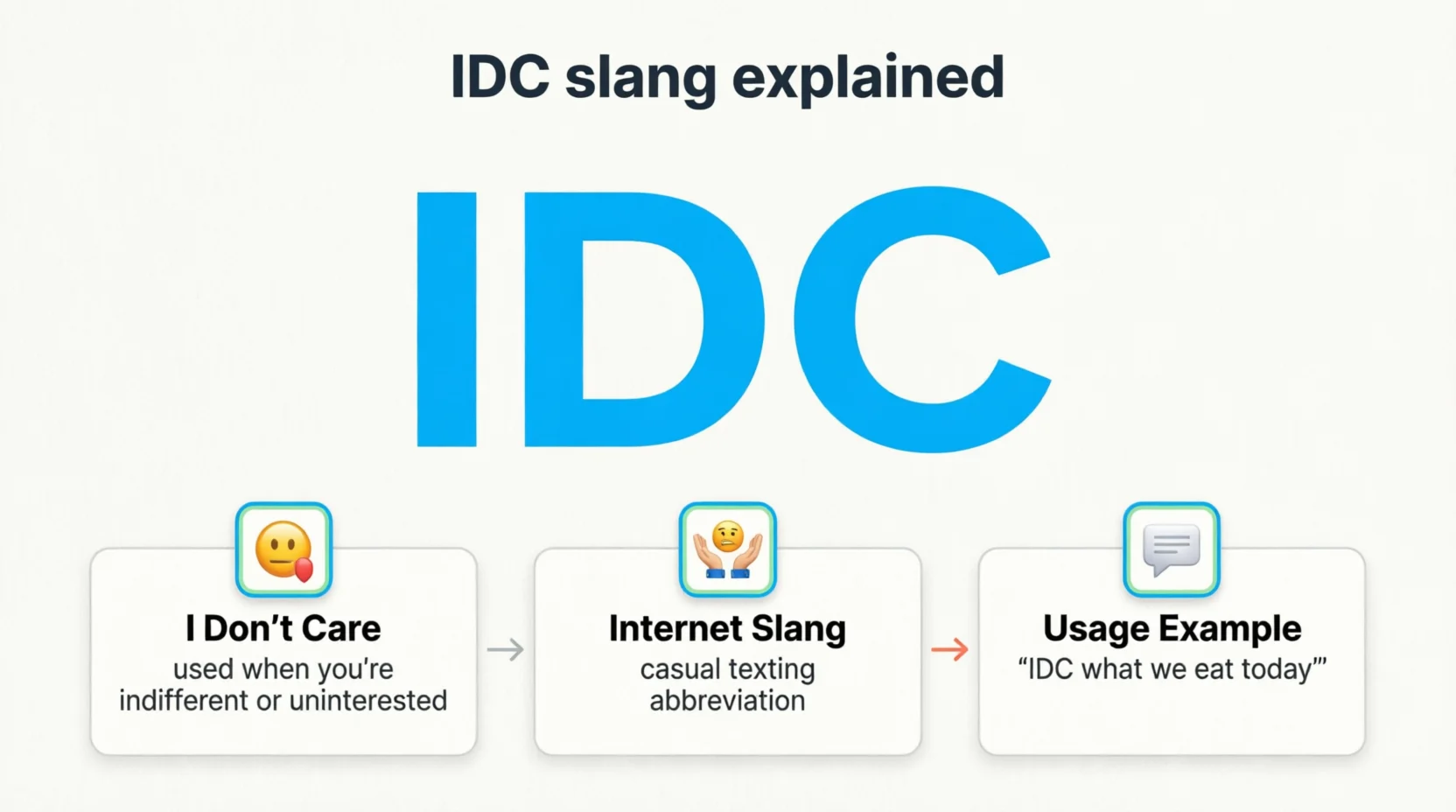
Have you ever received a message that simply said “IDC” and wondered whether the person was annoyed, joking, or just trying to end the conversation?
You’re not alone.
Internet slang moves fast, and short abbreviations like IDC appear everywhere—from text messages and Snapchat chats to TikTok comments and gaming communities. While it may look like just three letters, the meaning behind it can vary depending on the situation.
In this guide, you’ll learn exactly what IDC meaning is, when people use it, how to respond, and whether it’s considered rude or not.
Let’s break it down.
What Does IDC Mean?
IDC stands for “I Don’t Care.”
It’s a popular internet abbreviation used in texting, social media, online chats, and gaming conversations.
Quick Definition
IDC means “I Don’t Care” and is used to show that someone is not interested, has no preference, or doesn’t consider something important.
Depending on the tone and context, IDC can sound:
- Neutral ✅
- Casual ✅
- Indifferent ✅
- Dismissive ⚠️
- Rude ⚠️
This is why understanding the situation is important before using it.
Simple Meaning of IDC
In the simplest terms, IDC is a faster way of saying:
“It doesn’t matter to me.”
or
“I’m okay with any option.”
For example:
Friend: Where do you want to eat tonight?
You: IDC, you choose.
Here, IDC simply means you’re happy with whatever decision the other person makes.
However, the same abbreviation can feel much harsher in another situation:
Friend: Do you even care what people think?
Reply: IDC.
In this case, it sounds more blunt and dismissive.
That’s why context matters.
Where Is IDC Used?
IDC is commonly found across the internet and in everyday digital conversations.
Text Messages
People often use IDC when they don’t have a preference.
Example:
- “IDC which movie we watch.”
Social Media
You’ll see IDC in comments and replies on platforms such as:
- TikTok
- X (Twitter)
- Threads
Example:
- “IDC what anyone says, this song is amazing.”
Snapchat
Snapchat users frequently use IDC in casual conversations.
Example:
- “IDC if it’s raining, let’s go.”
Gaming Communities
Gamers often use IDC during team discussions or chats.
Example:
- “IDC what role I play.”
Online Forums
People use IDC to express an opinion or lack of concern.
Example:
- “IDC about the latest update. The game still works fine.”
Why Do People Use IDC?
The main reason is convenience.
Typing three letters is much faster than writing “I don’t care” every time.
But there are other reasons too.
1. To Show No Preference
Someone genuinely doesn’t mind either option.
Example:
- “IDC where we sit.”
2. To Express Confidence
People sometimes use IDC to show they aren’t bothered by criticism.
Example:
- “IDC what haters think.”
3. To End a Discussion
Some people use IDC when they don’t want to continue debating.
Example:
- “IDC anymore. Let’s move on.”
4. To Sound Casual
Among friends, IDC can simply be a relaxed response.
Example:
- “IDC, whatever works.”
Real-Life IDC Examples Explained
Understanding real examples makes internet slang much easier to remember.
Example 1
Friend: Pizza or burgers?
You: IDC.
Meaning: You have no preference.
Example 2
Comment: That movie was terrible.
Reply: IDC, I loved it.
Meaning: Other opinions don’t affect your view.
Example 3
Friend: People might laugh at your outfit.
You: IDC.
Meaning: You’re not worried about what others think.
Example 4
Teammate: Which character should we choose?
You: IDC, pick anyone.
Meaning: Any choice is fine.
Example 5
Friend: Why aren’t you responding?
Reply: IDC anymore.
Meaning: The person has lost interest in the discussion.
IDC vs Similar Internet Slang Terms
Many abbreviations look similar to IDC but have different meanings.
| Term | Meaning | Usage |
|---|---|---|
| IDC | I Don’t Care | No preference or concern |
| IDK | I Don’t Know | Lack of knowledge |
| IMO | In My Opinion | Sharing personal opinion |
| TBH | To Be Honest | Giving honest thoughts |
| NVM | Never Mind | Ignore previous statement |
| BRB | Be Right Back | Leaving temporarily |
| SMH | Shaking My Head | Disappointment or disbelief |
IDC vs IDK
This is one of the most common confusions.
IDC = I Don’t Care
Example:
- “IDC where we go.”
IDK = I Don’t Know
Example:
- “IDK where we should go.”
One means you have no preference.
The other means you don’t have the answer.
When Should You Use IDC?
IDC works best in casual conversations.
Good Situations
✅ Talking with friends
✅ Casual texting
✅ Gaming chats
✅ Social media comments
✅ Informal group conversations
Examples:
- “IDC which game we play.”
- “IDC what color we choose.”
- “IDC if we’re a little late.”
Situations to Avoid
⚠️ Professional emails
⚠️ Workplace conversations
⚠️ Customer communication
⚠️ Serious personal discussions
⚠️ Formal messages
For example:
Instead of saying:
- “IDC about the project deadline.”
A professional alternative would be:
- “I’m flexible regarding the deadline.”
Is IDC Rude?
This depends entirely on tone and context.
When IDC Is Not Rude
If you’re simply expressing flexibility:
- “IDC which restaurant we choose.”
Most people won’t find that offensive.
When IDC Can Sound Rude
If you’re dismissing someone’s feelings:
- “IDC what happened.”
This can come across as cold or insensitive.
A good rule is to think about how the other person might interpret your message.
Without facial expressions or voice tone, text messages can easily be misunderstood.
Common Misunderstandings About IDC
Misunderstanding #1: IDC Always Means Anger
Not true.
Many people use it casually without any negative feelings.
Misunderstanding #2: IDC Means Someone Doesn’t Respect You
Not necessarily.
Sometimes it simply means they don’t have a preference.
Misunderstanding #3: IDC Is Always Rude
Again, context matters.
Among close friends, IDC is often completely normal.
Misunderstanding #4: IDC and IDK Mean the Same Thing
They don’t.
IDC = I Don’t Care
IDK = I Don’t Know
Mixing them up can create confusion.
Pro Tips for Using IDC Correctly
🔥 Consider the Situation
Think about who you’re talking to.
A close friend may understand IDC differently than a coworker.
🔥 Add Context
Instead of only saying “IDC,” provide a little explanation.
Example:
- “IDC, either option sounds good.”
This sounds friendlier.
🔥 Avoid Using It During Emotional Conversations
If someone is sharing something important, IDC may seem dismissive.
Instead, respond thoughtfully.
🔥 Watch Your Tone
Short messages can appear harsher than intended.
Adding a smiley or extra words can soften the message.
Example:
- “IDC 😊 whichever works best for you.”
🔥 Use Alternatives When Necessary
If you want to sound more polite, try:
- “I’m okay with either.”
- “Whatever you prefer.”
- “I’m flexible.”
- “Your choice.”
How to Respond When Someone Says IDC
Your response depends on the situation.
If They’re Flexible
You can simply make the decision.
Example:
Them: IDC where we eat.
You: Great, let’s get pizza.
If They Sound Upset
You might ask for clarification.
Example:
Them: IDC anymore.
You: Everything okay?
If They’re Being Dismissive
You may choose to continue the conversation later or address the issue directly.
Example:
Them: IDC.
You: It sounds like you don’t want to discuss this right now.
The Evolution of IDC in Internet Culture
Like many online abbreviations, IDC became popular because digital communication rewards speed and convenience.
As texting, instant messaging, and social media grew, users started shortening common phrases.
Today, IDC is recognized across:
- Social media platforms
- Online gaming communities
- Messaging apps
- Forums
- Group chats
It’s now considered one of the most widely understood internet slang abbreviations.
Final Thoughts
The IDC meaning is simple: “I Don’t Care.”
However, the way people interpret it depends heavily on context, tone, and the relationship between the people communicating.
Sometimes IDC means you’re flexible and easygoing. Other times it can sound dismissive or uninterested.
If you’re unsure whether to use it, ask yourself one question:
Could this message be misunderstood?
If the answer is yes, adding a few extra words can make your meaning much clearer.
Understanding abbreviations like IDC helps you communicate more effectively online and avoid unnecessary confusion.
Frequently Asked Questions (FAQ)
What does IDC stand for in texting?
IDC stands for “I Don’t Care.” It is commonly used in text messages, social media, and online conversations to show a lack of preference or concern.
Is IDC rude?
Not always. IDC can be completely harmless when expressing flexibility, but it may sound rude if used to dismiss someone’s feelings or opinions.
What’s the difference between IDC and IDK?
IDC means “I Don’t Care.”
IDK means “I Don’t Know.”
They have very different meanings and should not be used interchangeably.
Can I use IDC in professional communication?
It’s generally best to avoid IDC in professional settings because it can sound careless or dismissive. Use more polite alternatives such as “I’m flexible” or “Either option works for me.”
descover more post
What Does What Does IK Mean in Text … – Clearly Meaning
GLHF Meaning in Text The Friendly Gaming Phrase Everyone …
What Does MFW Mean in Text Real Meaning Examples 2026

Navo is the voice behind ClearlyMeaning, where he breaks down confusing words and trending internet slang into simple, clear explanations. Known for his hardworking approach and attention to detail, he aims to make learning meanings quick, easy, and stress-free for readers. His goal is to provide helpful content that truly adds value.