
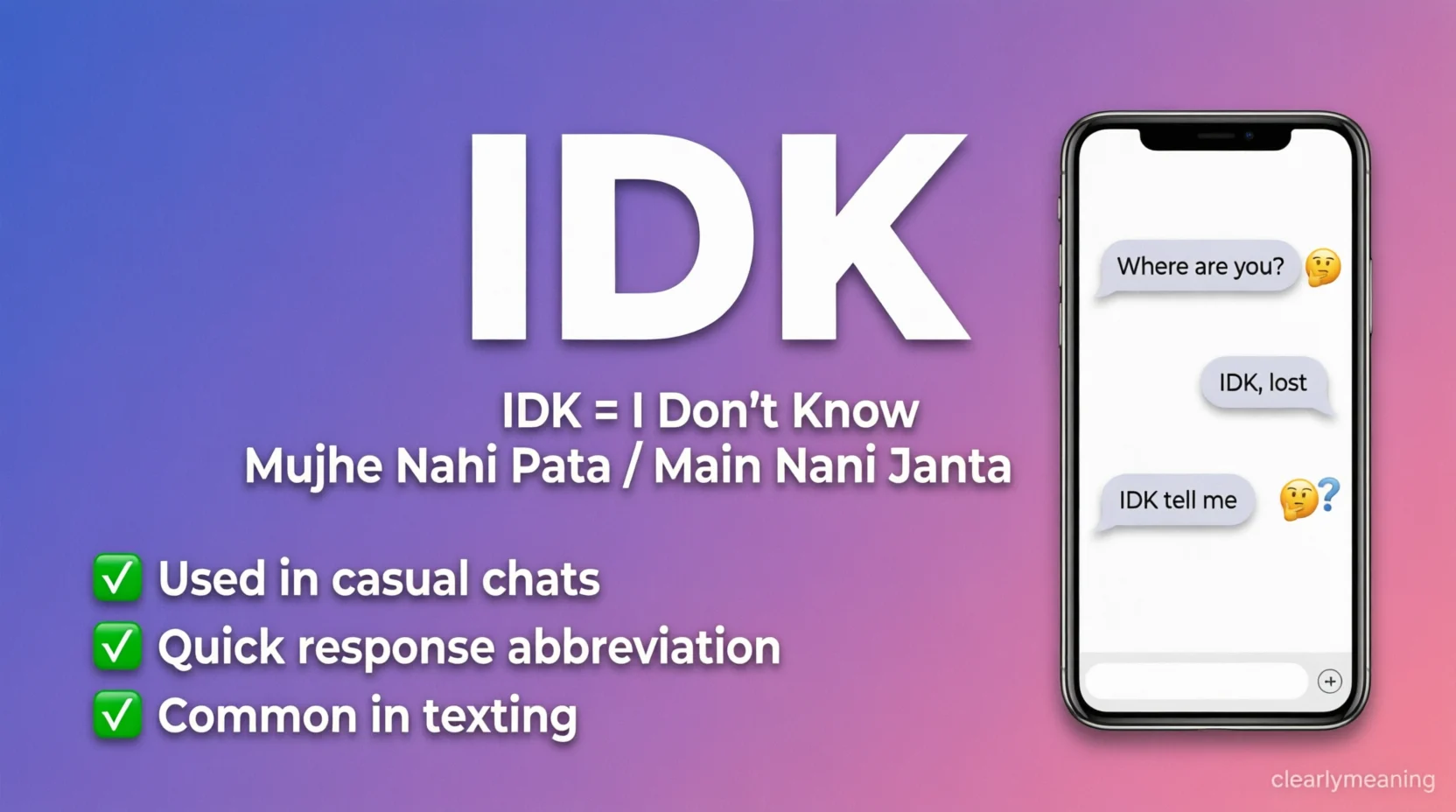
Have you ever received a text that simply says “IDK” and wondered whether the person is confused, uninterested, annoyed, or just being casual?
You’re not alone. IDK is one of the most common abbreviations used in texting, social media, online chats, and everyday digital conversations. It is short, quick, and easy to type—but the meaning behind it can sometimes depend on the situation and the person using it.
So, what does IDK mean in text? Let’s break it down in simple terms, look at real-life examples, and explain how you can use it naturally without misunderstanding the tone. 👇
What Does IDK Mean?
IDK means “I Don’t Know.”
People use this abbreviation when they do not know the answer to something, are unsure about a situation, or simply do not have enough information to respond.
Quick definition:
IDK = I Don’t Know
For example:
Person 1: “What time does the movie start?”
Person 2: “IDK, maybe around 8?”
In this example, IDK simply means the person does not know the exact answer.
The abbreviation is usually casual and informal. You will commonly see it in text messages, Snapchat conversations, Instagram DMs, TikTok comments, Discord chats, and other online conversations.
IDK Meaning in Simple Words
In simple English, IDK is just a shorter way of saying:
- I don’t know.
- I’m not sure.
- I have no idea.
- I don’t have the answer.
The meaning is usually straightforward, but the tone can change depending on the conversation.
For example:
“IDK what to wear tonight 😂”
This sounds casual and playful.
But:
“IDK.”
That short reply might sound less enthusiastic, especially if someone expected a detailed answer.
This is why understanding the context is important. The letters IDK have the same basic meaning, but the emotion behind them can vary.
Where Is IDK Used? 📱
You can find IDK almost anywhere people communicate online.
Common places where people use IDK include:
- Text messages
- Snapchat
- Instagram DMs
- TikTok comments
- Facebook Messenger
- Discord
- Online gaming chats
- Group chats
- Casual emails and messages
The abbreviation is especially popular among people who want to type quickly.
Instead of writing:
“I don’t know what we should do tonight.”
Someone might simply write:
“IDK what we should do tonight 😭”
It saves time and makes the conversation feel more relaxed.
Why Do People Use IDK?
There are several reasons people use IDK instead of writing the complete phrase “I don’t know.”
1. It Saves Time
Texting is often fast. People do not always want to type every word, especially when they are having a quick conversation.
“IDK” takes only three letters and communicates the same basic idea.
2. It Sounds Casual
Using abbreviations can make a message feel more natural and relaxed.
For example:
“I don’t know what happened.”
sounds slightly more formal than:
“IDK what happened lol.”
Neither is wrong. The second version simply feels more like everyday online conversation.
3. It Shows Uncertainty
Sometimes you genuinely do not know the answer.
Example:
Friend: “Is Sarah coming to the party?”
You: “IDK, she hasn’t replied to me.”
Here, IDK clearly shows uncertainty.
4. It Can Express Confusion
People may also use IDK when they are confused about something.
“IDK why my phone keeps restarting.”
This means:
“I don’t know why my phone keeps restarting.”
5. It Can Make a Message Feel Less Serious
Adding IDK can sometimes soften a statement.
“IDK, maybe we should talk about it later.”
This sounds less direct than:
“We should talk about it later.”
The exact tone depends on the conversation.
Real-Life Examples of IDK in Text 💬
Here are some common examples of how people use IDK in everyday conversations.
Example 1: Asking About Plans
Friend: “What are we doing this weekend?”
You: “IDK yet. Maybe we can go out for dinner.”
Meaning: You have not decided your plans yet.
Example 2: Not Knowing an Answer
Person 1: “Who won the game?”
Person 2: “IDK, I wasn’t watching.”
Meaning: The person genuinely does not know.
Example 3: Showing Uncertainty
Friend: “Do you think he’ll come?”
You: “IDK honestly.”
Meaning: You are unsure and do not want to make a definite prediction.
Example 4: Casual Conversation
Friend: “What do you want to eat?”
You: “IDK 😭 you choose.”
Meaning: You do not have a preference and want the other person to decide.
Example 5: Confusion
Person 1: “Why is the website not working?”
Person 2: “IDK 😭 it was fine five minutes ago.”
Meaning: The person is confused about what happened.
Example 6: A Short Reply
Person 1: “Are you coming tomorrow?”
Person 2: “IDK.”
This could mean the person is genuinely uncertain. However, depending on the conversation, it might also sound a little dry or uninterested.
That is why punctuation, emojis, and context can affect the tone.
What Does IDK Mean on Snapchat?
On Snapchat, IDK still means “I Don’t Know.”
There is no special Snapchat-only meaning for the abbreviation.
For example:
“IDK what happened 😂”
means:
“I don’t know what happened.”
You might see IDK in:
- Snaps
- Chat messages
- Group conversations
- Story replies
Snapchat conversations are usually informal, so abbreviations like IDK, LOL, TBH, and OMG are very common.
What Does IDK Mean on Instagram?
On Instagram, IDK also means “I Don’t Know.”
Someone might use it in a direct message or comment.
Example:
You: “Which outfit should I post?”
Friend: “IDK, I like both 😭”
Here, the person is saying they are unsure which outfit is better.
In Instagram comments, someone might write:
“IDK why this is so funny 😂”
This means:
“I don’t know why this is so funny.”
It is often used in a playful or humorous way.
IDK vs Similar Texting Abbreviations
Although IDK is simple, it can be confused with other expressions that communicate uncertainty or a lack of knowledge.
| Texting Term | Meaning | Typical Tone |
|---|---|---|
| IDK | I Don’t Know | Casual and neutral |
| IKR | I Know, Right? | Agreement |
| IDC | I Don’t Care | Indifferent or dismissive |
| IMO | In My Opinion | Sharing an opinion |
| TBH | To Be Honest | Honest opinion or statement |
| NGL | Not Gonna Lie | Informal honesty |
| IDTS | I Don’t Think So | Disagreement or uncertainty |
| WYM | What You Mean? | Asking for clarification |
IDK vs IDC
These two are especially important to understand.
IDK = I Don’t Know
IDC = I Don’t Care
Example:
“IDK where he went.”
= I don’t know where he went.
“IDC where he went.”
= I don’t care where he went.
They may look similar, but their meanings are completely different. ⚠️
When Should You Use IDK?
You can use IDK when you are chatting casually with people you know.
It works well in:
- Text messages
- Friendly conversations
- Group chats
- Social media messages
- Gaming chats
- Casual online discussions
Good examples:
“IDK what time I’ll be home.”
“IDK, what do you think?”
“IDK how to explain it 😂.”
“IDK if I can make it tonight.”
The abbreviation is natural in informal communication.
When Should You Avoid Using IDK?
Although IDK is common, it is not appropriate for every situation.
You should generally avoid it in formal or professional communication.
For example, instead of writing:
“IDK when the report will be ready.”
to your manager or a professional client, you could say:
“I’m not sure when the report will be ready, but I’ll confirm the timeline shortly.”
The more formal version sounds more professional and helpful.
Avoid IDK in:
- Formal business emails
- Job applications
- Academic assignments
- Professional reports
- Official customer-service communication
- Important workplace messages
Of course, the right choice depends on the relationship and the communication style of the people involved.
Does IDK Sound Rude?
Not necessarily.
The abbreviation itself is not rude. However, a very short reply can sometimes sound dismissive.
Compare these messages:
Message 1:
“IDK.”
This can sound dry, especially if someone asked an important question.
Message 2:
“IDK honestly 😭 maybe ask Alex?”
This feels more friendly and helpful.
Message 3:
“I’m not sure, but I’ll find out.”
This sounds more thoughtful and professional.
The difference is not the abbreviation itself. It is the context, wording, punctuation, and effort behind the reply.
If you want to sound friendlier, add a little more information.
Instead of:
“IDK.”
Try:
“IDK honestly, let me check.”
or:
“IDK 😭 I haven’t heard anything yet.”
Common Misunderstandings About IDK
Misunderstanding 1: IDK Always Means the Person Is Annoyed
This is not true.
Most of the time, IDK simply means “I Don’t Know.”
Someone may be busy, distracted, or genuinely unsure.
Do not automatically assume they are angry because they replied with IDK.
Misunderstanding 2: IDK Means “I Don’t Care”
This is a common mistake.
IDK means I Don’t Know.
IDC means I Don’t Care.
These are completely different expressions.
Misunderstanding 3: IDK Is Only Used by Teenagers
Not at all.
People of many different ages use common texting abbreviations. The popularity of a term may vary by age group and platform, but IDK is widely understood online.
Misunderstanding 4: IDK Always Has a Negative Tone
Again, context matters.
“IDK 😂” may sound playful.
“IDK.” may sound short or uncertain.
“IDK honestly, I’m still thinking about it.” sounds thoughtful.
The surrounding words usually reveal the real tone.
Pro Tips for Using IDK Naturally ✅
If you want to use IDK naturally in your conversations, keep these tips in mind.
1. Match the Situation
Use IDK in casual conversations, but choose more complete wording in professional situations.
2. Add Context When Necessary
A simple “IDK” may leave the other person confused.
Instead, you can say:
“IDK yet, but I’ll let you know.”
This gives the conversation more clarity.
3. Use Emojis to Show Tone
In casual chats, an emoji can make your message feel warmer.
“IDK 😂”
feels different from:
“IDK.”
The emoji helps communicate emotion.
4. Don’t Overthink Every Short Reply
If someone sends IDK, do not immediately assume they are upset.
Look at the entire conversation before deciding what they mean.
5. Remember That Tone Depends on Context
The same abbreviation can sound different depending on the situation.
“IDK lol” sounds casual.
“IDK…” may sound uncertain or frustrated.
“IDK, maybe.” sounds hesitant.
Small details can change the feeling of a message.
Other Common Ways to Say IDK
If you want to express the same idea in different ways, you can use:
- I don’t know
- I’m not sure
- No idea
- I have no clue
- Not sure tbh
- Your guess is as good as mine
- I honestly have no idea
- Hmm, I’m not sure
The best choice depends on how casual or formal you want to sound.
For example:
Casual: “IDK 😂”
Friendly: “I’m not sure, honestly.”
Very casual: “No idea lol.”
Professional: “I’m not certain, but I’ll check and confirm.”
Final Thoughts 💡
So, what does IDK mean?
It simply means “I Don’t Know.” People use it in texts, social media, online chats, and everyday digital conversations when they are unsure, confused, or do not have an answer.
The abbreviation is short, casual, and extremely common. However, the tone can change depending on the wording around it.
“IDK 😂” may sound playful, while “IDK.” might feel a little dry. When you understand the context, it becomes much easier to know what someone really means.
The next time someone sends you IDK, you can usually take it literally: they simply don’t know. 😊
Frequently Asked Questions
What does IDK mean in texting?
IDK means “I Don’t Know.” It is a common informal abbreviation used in text messages, social media, online chats, and casual conversations.
What does IDK mean on Snapchat?
On Snapchat, IDK means “I Don’t Know.” It has the same meaning as it does in regular texting and is commonly used in casual chats and Snaps.
Is IDK rude?
IDK is not automatically rude. However, replying with only “IDK” can sometimes sound short or dismissive depending on the conversation. Adding more words or an emoji can make the message feel friendlier.
What is the difference between IDK and IDC?
IDK means “I Don’t Know,” while IDC means “I Don’t Care.” These abbreviations have completely different meanings, so it is important not to confuse them.
descover more post
What Does WDYM Meaning in Text Real Meaning Examples …
FYM Meaning Explained The Viral Text Slang Everyone Is …
What Does What Does POS Mean in Text Mean in Text Real …

M. Khan is the writer behind ClearlyMeaning, where he breaks down difficult words and trending internet slang into simple, clear explanations. Known for his hardworking approach and attention to detail, he aims to make understanding language easy and stress-free for readers worldwide.