
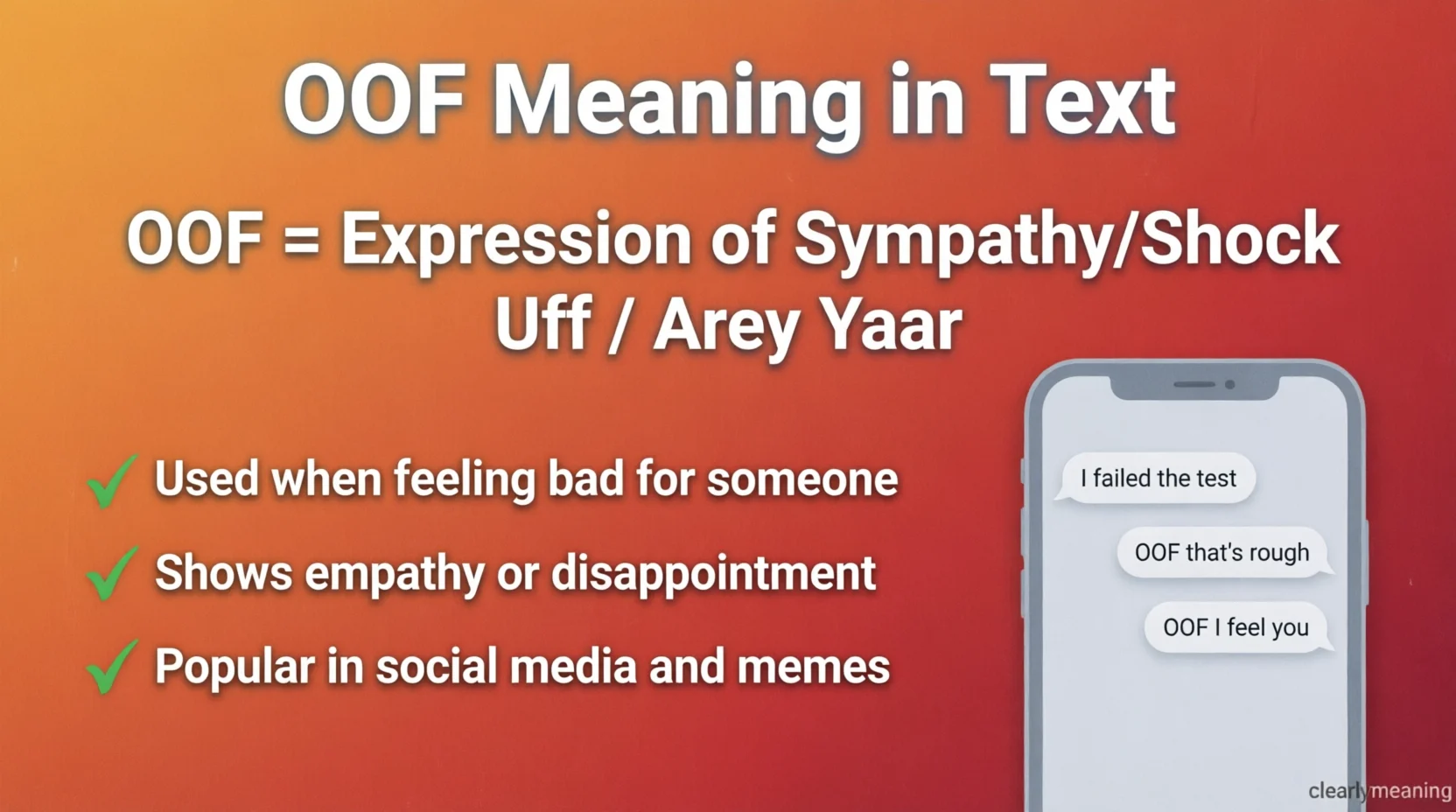
Have you ever opened a message, seen something painfully awkward, surprising, or unfortunate, and had no idea what to say? You might simply reply: “Oof.”
This short expression has become incredibly common in texting, social media comments, gaming chats, and everyday online conversations. But what does “oof” actually mean?
The oof meaning usually expresses a reaction to something painful, awkward, embarrassing, disappointing, shocking, or emotionally difficult. Depending on the situation, it can mean something like “That hurts,” “That’s awkward,” “Wow, that’s unfortunate,” or “I feel that.”
For example:
Friend: “I studied all night and still failed the test.”
You: “Oof 😬”
In this case, “oof” shows sympathy and acknowledges that the situation is unpleasant.
But there is more to this simple word than you might think. Its meaning can change depending on the context, tone, and conversation. Let’s break it down in a simple way.
What Does Oof Mean?
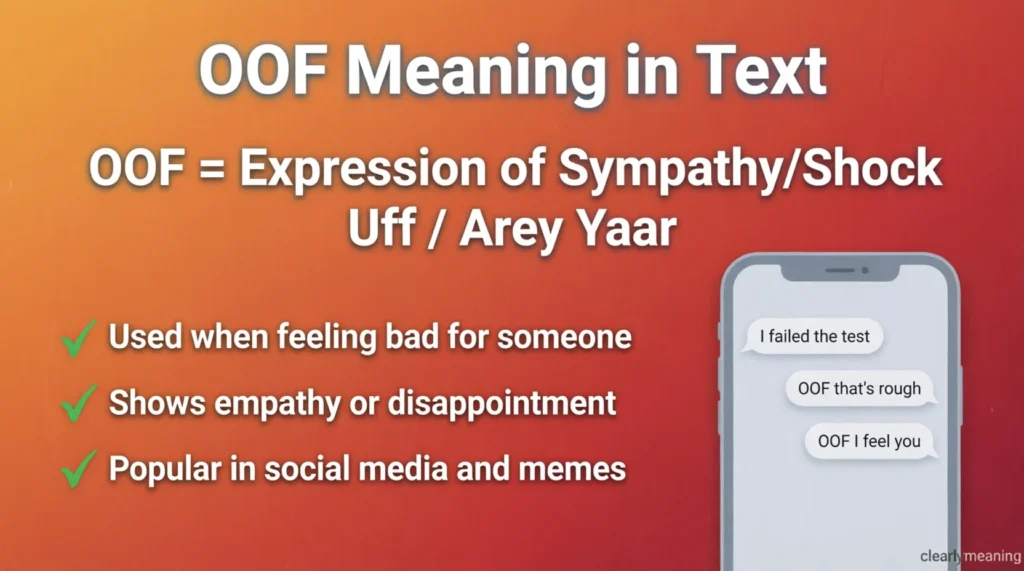
“Oof” is an informal expression used to react to something painful, awkward, embarrassing, difficult, surprising, or unfortunate.
In texting and online conversations, it can express:
- Pain: “Oof, that must have hurt.”
- Awkwardness: “Oof, that was uncomfortable.”
- Disappointment: “Oof, you missed the deadline.”
- Sympathy: “Oof, I’m sorry that happened.”
- Shock: “Oof, I wasn’t expecting that.”
- Emotional impact: “Oof, that hit hard.”
The exact meaning depends on the situation.
Someone might say “oof” after hearing bad news, seeing an embarrassing moment, losing a game, or even reading an emotional message. It is a flexible reaction word that lets you respond without writing a long explanation.
Quick Definition
Oof means a reaction to something painful, awkward, unfortunate, surprising, or emotionally difficult. It is similar to saying “ouch,” “wow,” “that hurts,” or “that’s rough.”
Oof Meaning in Simple Words
In simple English, “oof” is something you say when a situation makes you react emotionally.
Imagine someone tells you:
“I accidentally sent my private message to the entire group chat.”
You might reply:
“Oof 😭”
You are not literally saying that you are physically hurt. Instead, you are reacting to how embarrassing or uncomfortable the situation sounds.
Similarly:
“I got rejected from my dream job.”
“Oof. I’m really sorry.”
Here, “oof” shows that you understand the situation is painful or disappointing.
The word is often short, but it can communicate a surprisingly strong reaction.
Where Is “Oof” Used?
You can see oof almost anywhere people communicate casually online.
Text Messages
Friends often use “oof” in private conversations.
Example:
Friend: “My phone fell into the water.”
You: “Oof 😭”
The response shows sympathy and recognizes that the situation is unfortunate.
Social Media Comments
People frequently comment “oof” under posts, videos, and pictures.
For example, someone may post a video of a person missing an easy basketball shot. A comment might simply say:
“Oof 💀”
This can mean the mistake was painful, embarrassing, or funny to watch.
Gaming Chats
“Oof” is also popular in gaming conversations.
Player 1: “I lost the final round with one point left.”
Player 2: “Oof.”
Here, the word expresses disappointment or sympathy.
Group Chats
In a group chat, “oof” can be a quick reaction to dramatic or awkward news.
Person A: “I just realised I replied to the wrong person.”
Person B: “Oof 😬”
Memes and Online Culture
The expression is commonly used in memes, reaction posts, and short-form videos. Its simplicity makes it perfect for situations where a longer response is unnecessary.
Why Do People Say “Oof”?
There are several reasons people use this expression.
1. It Is Short and Easy
You do not always need a long response. Sometimes, “oof” says everything.
If a friend tells you something unfortunate, typing:
“Oof, that’s rough.”
can be quicker and more natural than writing a full paragraph.
2. It Shows Empathy
“Oof” can show that you understand someone has experienced something difficult.
For example:
Friend: “My car broke down on the way to work.”
You: “Oof, that’s frustrating.”
The first word acknowledges the problem, while the rest of the sentence adds support.
3. It Reacts to Awkward Moments
Sometimes something is so uncomfortable that you do not know what else to say.
Person: “He said ‘you too’ after the waiter told him to enjoy his meal.”
You: “Oof 😭”
This usually means:
“That was awkward.”
4. It Can Be Funny
“Oof” is not always serious. People also use it humorously.
Friend: “I spent £50 on snacks and finished them in one night.”
You: “Oof 😂”
The reaction may be playful rather than genuinely sympathetic.
5. It Expresses Emotional Impact
Sometimes a message affects you emotionally.
“She said she was proud of me, and honestly, that hit differently.”
“Oof 🥺”
Here, “oof” can mean the statement was emotionally powerful.
Real-Life Examples of Oof in Texting
Understanding examples is one of the easiest ways to learn how the word works.
Example 1: Physical Pain
Person A: “I walked into the table again.”
Person B: “Oof 😭”
Meaning: That sounds painful.
Example 2: Bad Luck
Person A: “I missed my train by literally five seconds.”
Person B: “Oof, that’s unlucky.”
Meaning: That is unfortunate.
Example 3: Embarrassment
Person A: “I waved back at someone who wasn’t waving at me.”
Person B: “Oof 💀”
Meaning: That was awkward or embarrassing.
Example 4: Relationship Problems
Person A: “She said she only sees me as a friend.”
Person B: “Oof. I’m sorry.”
Meaning: That must hurt emotionally.
Example 5: Academic Disappointment
Person A: “I got 48% on the exam.”
Person B: “Oof 😬”
Meaning: That is disappointing or difficult.
Example 6: Gaming
Player A: “I was about to win, then my internet disconnected.”
Player B: “Oof 💀”
Meaning: That is extremely unfortunate.
Example 7: Funny Situation
Friend: “I confidently answered a question and got everything wrong.”
You: “Oof 😂”
Meaning: That was embarrassing but funny.
Example 8: Emotional Situation
Person A: “My little brother told me I’m his hero.”
Person B: “Oof, that’s adorable 🥹”
Meaning: That was emotionally touching.
Oof vs Similar Words
Although “oof” is similar to several reaction words, each expression has a slightly different feeling.
| Expression | Common Meaning | Example |
|---|---|---|
| Oof | Reaction to pain, awkwardness, difficulty, or bad luck | “Oof, that must hurt.” |
| Ouch | Usually direct physical or emotional pain | “Ouch, that sounds painful.” |
| Yikes | Shock, concern, or discomfort | “Yikes, that conversation went badly.” |
| Bruh | Surprise, disbelief, frustration, or amusement | “Bruh, how did you do that?” |
| Damn | Strong surprise, disappointment, or admiration | “Damn, that was unexpected.” |
| F | Showing sympathy for a loss or unfortunate event | “You lost your save file? F.” |
| RIP | A humorous or serious reaction to something being ruined or lost | “RIP to your weekend.” |
The Difference Between “Oof” and “Ouch”
“Ouch” is usually more directly connected to pain.
“Ouch, I hit my hand.”
“Oof” is broader and can be used for physical pain, emotional pain, awkwardness, disappointment, or bad luck.
“Oof, you got rejected?”
So, “oof” has a wider range of meanings in casual online communication.
What Does “Oof” Mean on Social Media?
On social media, oof is usually a quick reaction to something uncomfortable, painful, embarrassing, or unfortunate.
For example, someone might post:
“I just realised I was in the wrong group chat for ten minutes.”
A comment might say:
“Oof 😭”
In this context, the commenter is reacting to the embarrassment.
However, the meaning can change based on the emoji used.
“Oof 😭”
Usually means:
- That is painful
- I feel bad for you
- This is extremely unfortunate
“Oof 😂”
Usually means:
- That is embarrassing but funny
- I cannot believe that happened
“Oof 💀”
Often means:
- That was painfully awkward
- I am shocked
- That situation is hilarious
“Oof 😬”
Usually means:
- That is uncomfortable
- That was a bad situation
- I do not know what to say
“Oof 🥺”
Often expresses:
- Sympathy
- Emotional impact
- Tenderness or sadness
The emoji helps make the intended tone clearer.
When Should You Use “Oof”?
You can use oof in casual conversations when you want to react naturally to something that seems painful, awkward, surprising, or unfortunate.
Good situations include:
- A friend has bad luck
- Someone shares an embarrassing story
- A person loses a game
- Someone experiences rejection
- A situation becomes awkward
- You hear disappointing news
- A funny mistake happens
- A message affects you emotionally
Example:
Friend: “I spent three hours writing an essay, then my computer crashed before I saved it.”
You: “Oof 😭 That is horrible.”
This sounds natural because “oof” provides an immediate emotional reaction, while the second sentence adds genuine support.
When Should You Avoid Saying “Oof”?
Although the word is common and casual, it is not appropriate for every situation.
Avoid Using It in Very Formal Communication
You probably would not write:
“Oof, I’m sorry to hear about the business loss.”
in a formal professional email.
Instead, you might say:
“I’m sorry to hear about this difficult situation.”
Be Careful With Serious Situations
If someone is discussing a serious personal problem, simply replying “oof” may sound dismissive.
For example:
Friend: “I’m going through a really difficult time.”
A better response might be:
“I’m really sorry. That sounds incredibly difficult.”
You can still use “oof” casually, but it should not replace genuine support when someone needs it.
Consider Your Relationship With the Person
“Oof” is most natural with friends, online communities, and casual conversations.
With someone you do not know well, the meaning may be unclear or seem too informal.
Common Misunderstandings About Oof
Misunderstanding 1: Oof Always Means Physical Pain
Not necessarily.
Although “oof” can describe physical pain, it is also used for:
- Emotional pain
- Awkwardness
- Disappointment
- Shock
- Bad luck
- Humour
The context determines the meaning.
Misunderstanding 2: Oof Is Always Negative
Most uses involve something difficult or uncomfortable, but the word can sometimes be playful or emotionally positive.
For example:
“My baby cousin just gave me a hug and said I’m her favourite.”
“Oof, my heart 🥹”
Here, “oof” shows strong emotion rather than sadness.
Misunderstanding 3: Oof Is Always Sarcastic
Not at all.
“Oof” can be sincere:
“Oof, I’m sorry you’re dealing with that.”
It can also be sarcastic or humorous:
“Oof, imagine forgetting your own password again 😂”
The tone depends on the conversation.
Misunderstanding 4: One Meaning Works Everywhere
Like many slang expressions, “oof” changes slightly depending on context.
The same word can mean:
- “That hurts.”
- “That is awkward.”
- “That is unfortunate.”
- “Wow, I feel that.”
- “That was funny.”
- “That is emotionally powerful.”
Always look at the message around it.
Pro Tips for Using “Oof” Naturally 🔥
If you want to use the word naturally in conversations, these tips can help.
✅ Add a Second Sentence When Sympathy Matters
Instead of only saying:
“Oof.”
Try:
“Oof, I’m sorry. That sounds really frustrating.”
This makes your response feel more caring.
✅ Use Emojis to Clarify Your Tone
Because “oof” can have several meanings, an emoji can make your intention clearer.
- 😭 = extreme sadness or pain
- 😂 = funny embarrassment
- 💀 = shocked or hilariously awkward
- 😬 = uncomfortable
- 🥺 = emotional or sympathetic
✅ Match the Other Person’s Mood
If someone is joking, a playful “oof 😂” may work well.
If someone is genuinely upset, use a more supportive response.
⚠️ Do Not Overuse It
Using “oof” in every conversation can make your replies feel repetitive.
It works best as a natural reaction when the situation genuinely calls for it.
✅ Remember That Context Matters Most
The word itself is simple. The situation gives it meaning.
Before replying, ask yourself:
Is this painful, awkward, surprising, disappointing, funny, or emotionally intense?
If yes, “oof” may be a natural response.
Is “Oof” a Slang Word?
Yes, oof is commonly considered an informal expression or internet slang term.
It is especially popular in:
- Texting
- Social media
- Gaming
- Memes
- Online comments
- Casual conversations
Because it is informal, you should avoid using it in highly formal writing unless you are intentionally using a conversational tone.
Is “Oof” Rude?
Usually, no. “Oof” is not automatically rude.
However, the way you use it can affect how it sounds.
For example:
“Oof, I’m sorry. That sounds tough.”
This sounds sympathetic.
But:
“Oof 😂”
after someone shares serious bad news could sound insensitive.
The key is to understand the situation and the person’s feelings.
Final Thoughts on Oof Meaning
So, what is the oof meaning?
In simple terms, “oof” is a casual reaction used when something is painful, awkward, unfortunate, surprising, disappointing, or emotionally powerful. It is similar to saying “ouch,” “that’s rough,” “wow,” or “I feel that.”
The exact meaning depends on the context and tone. A simple “oof 😭” might express sympathy, while “oof 💀” could describe hilariously embarrassing.
The best way to use it is to match the situation. When used naturally, this short expression can make your messages feel more emotional, relatable, and conversational. ✅
Frequently Asked Questions
What does oof mean in texting?
In texting, oof is a reaction to something painful, awkward, disappointing, surprising, or unfortunate. It can mean “ouch,” “that’s rough,” “wow,” or “I feel bad for you,” depending on the context.
What does oof mean from a girl or guy?
The meaning is generally the same whether a girl or guy says it. “Oof” usually shows a reaction to something uncomfortable, painful, awkward, surprising, or emotionally powerful. The surrounding conversation determines the exact meaning.
Is oof a bad word?
No. Oof is not a swear word or offensive term. It is an informal expression commonly used in texting, social media, gaming, and online conversations.
What is the difference between oof and ouch?
“Ouch” usually refers directly to physical or emotional pain, while “oof” has a broader meaning. It can express pain, awkwardness, disappointment, bad luck, shock, or sympathy.
descover more post
What Does GNG Mean in Text Real Meaning Examples 2026
FYM Meaning Explained The Viral Text Slang Everyone Is …
What Does What Does POS Mean in Text Mean in Text Real …

M. Khan is the writer behind ClearlyMeaning, where he breaks down difficult words and trending internet slang into simple, clear explanations. Known for his hardworking approach and attention to detail, he aims to make understanding language easy and stress-free for readers worldwide.